
Views: 0 Author: Site Editor Publish Time: 2026-09-03 Origin: Site


Heavy industries chew through standard equipment on a daily basis. Imagine a steel mill hopper or a coal transfer chute taking a brutal beating from tons of jagged ore every single hour. In these harsh environments, conventional steel and polyurethane wear out far too fast. When a chute blows out mid-shift, you are not just losing metal. You are losing thousands of dollars in halted production and introducing severe safety risks for your maintenance crew.
An alumina ceramic protection plate solves this fundamental engineering flaw. By shifting from metallic wear parts to advanced crystalline structures, facilities can exponentially increase equipment lifespan. In this comprehensive guide, we break down exactly how purity, hardness, and thickness interact to dictate the ultimate wear life of these protective barriers in the field.
Purity Dictates Performance: The specific choice between a 95% and 99% alumina composition fundamentally alters the material's density, mechanical strength, and overall cost-efficiency in demanding environments.
Hardness Equals Longevity: Ranking at a 9 on the Mohs scale, the extreme hardness of these ceramics prevents surface gouging, micro-cutting, and rapid degradation caused by abrasive ores.
Thickness Absorbs Impact: While surface hardness prevents scratching, the physical thickness of the panel is engineered to absorb heavy kinetic energy. This prevents catastrophic flexural failure and shattering.
Application is Everything: Whether you are lining heavy-duty mining chutes or designing ballistic armor, matching exact ceramic specifications to your operational environment is the only way to maximize lifespan.
At its core, an Al2O3 ceramic sheet is an advanced technical ceramic manufactured primarily from refined aluminum oxide powder. The production process involves highly controlled, precision engineering. Fine, high-purity alumina powder is mixed with specific organic binders and pressed into molds under extreme mechanical pressure. Following this initial pressing stage, the green material undergoes high-temperature sintering, typically baking in kilns at temperatures exceeding 1,500°C (2,732°F).
During this intense firing phase, the powder particles fuse at a microscopic level. This eliminates internal porosity and transforms the loose raw material into a dense, rigid, and nearly impenetrable crystalline structure. The resulting shield exhibits exceptional thermal stability, chemical inertness, and mechanical strength. It simply will not warp, melt, or scrape away like standard AR400 wear steel.
Alumina ceramics operate on a dual-action mechanical principle that adapts depending on their application. In bulk material handling, they provide a frictionless, ultra-hard barrier. When rough aggregates like coal, quartz, or iron ore slide across the surface, the ceramic's tight crystalline bonds refuse to yield. Instead of gouging the surface, the abrasive particles are deflected entirely.
Conversely, in tactical or ballistic scenarios, the physical mechanism shifts from friction resistance to kinetic energy dispersion. When struck by a high-velocity projectile, the extreme hardness of the ceramic blunts and shatters the leading edge of the threat. Simultaneously, the plate undergoes a process of controlled micro-fracturing. This cracking absorbs and dissipates the kinetic energy outward radially, ultimately preventing penetration.
Recent industrial market analyses highlight a massive shift in procurement strategies regarding wear materials. Global mining, cement, and bulk handling sectors are facing tighter margins and severe labor shortages. Consequently, facility managers are aggressively moving away from reactive maintenance—like constantly welding patch plates onto worn steel—toward predictive longevity.
The current market trajectory shows a surging demand for customized, pre-engineered ceramic liners. This is driven primarily by the global push for "zero-downtime" automated facilities. As operational costs soar, investing upfront in advanced alumina ceramics is no longer viewed as a premium luxury. It is now a mandatory engineering safeguard to ensure continuous, uninterrupted production.
Widely recognized as the standard workhorse for heavy industry, a 95% alumina ceramic delivers consistent, rugged performance. It consists of 95% aluminum oxide, with the remaining 5% comprising carefully selected sintering aids such as silica, magnesia, or calcium oxide. These crucial additives lower the required firing temperature and subtly improve the material's fracture toughness, making it slightly more forgiving under mechanical stress.
This specific purity level strikes an exceptional balance between cost-efficiency and endurance. Standard specifications typically feature a bulk density of at least 3.60 g/cm³ and a Rockwell hardness (HRA) of ≥85. It is the go-to material for extensive conveyor transfer points and deep storage hoppers where facilities require high friction resistance across massive surface areas without obliterating maintenance budgets.
Stepping up to a 99% composition introduces distinct, high-end engineering advantages. By reducing secondary additives to less than 1%, manufacturers achieve a much finer grain structure. This pushes the material closer to its maximum theoretical density, often exceeding 3.80 g/cm³.
Because of this tightly packed microstructure, a 99% alumina plate delivers superior Vickers hardness, enhanced stability at extreme temperatures, and near-total immunity to chemical corrosion. It is highly sought after in aerospace engine components, semiconductor manufacturing, and highly corrosive chemical processing plants where every single margin of performance dictates success or catastrophic failure.
| Specification | 95% Alumina Ceramic | 99% Alumina Ceramic |
|---|---|---|
| Bulk Density | ≥ 3.60 g/cm³ | ≥ 3.80 g/cm³ |
| Hardness (HRA) | ≥ 85 | ≥ 88 |
| Primary Strength | Excellent cost-to-wear ratio, good fracture toughness. | Extreme chemical inertness, high-temperature stability. |
| Best Applications | Mining chutes, coal hoppers, cement pipes. | Acid tanks, aerospace, premium ballistic armor. |
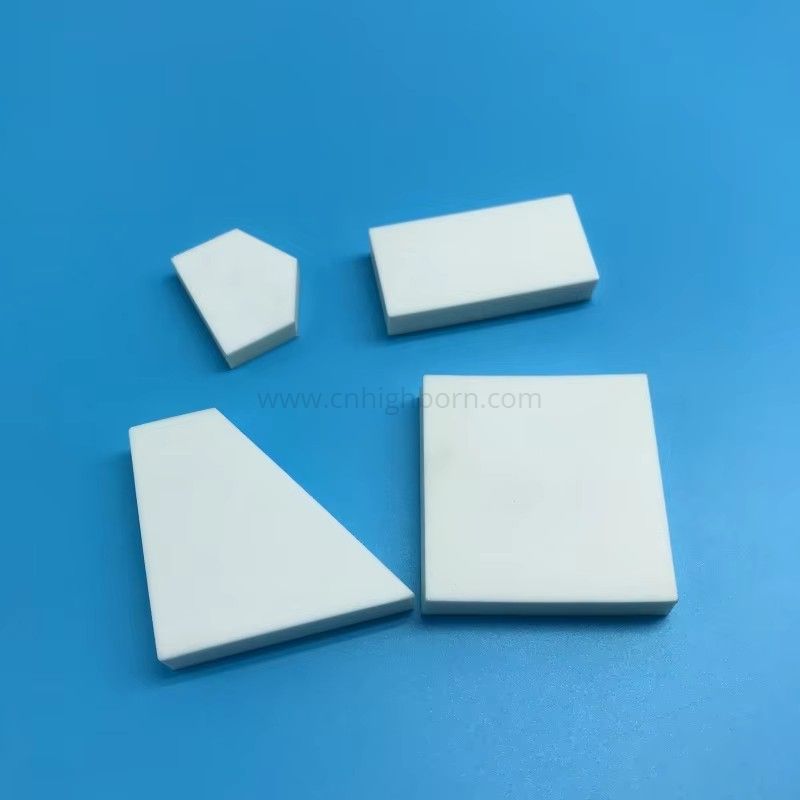
To truly grasp why these protective barriers last so long in the field, one must look at empirical hardness measurements. On the traditional Mohs scale of mineral hardness, alumina ranks at a solid 9. This places it just below diamond (10) and significantly above hardened industrial steel, which typically hovers around 5 to 6.5.
In strict engineering terms, hardness is more accurately quantified using the Vickers scale. A standard wear resistant ceramic plate exhibits a Vickers hardness (HV) ranging from 1,200 to 1,700, heavily dependent on sintering quality. To put this into perspective, quartz—one of the most common and destructive abrasive minerals found in mining—has an HV of roughly 1,100. Because the crystalline structure of the ceramic is fundamentally harder than the rocks sliding against it, scratching the surface becomes virtually impossible.
Industrial wear usually occurs through a process called micro-cutting or plowing. This is where sharp, jagged particles gouge out microscopic pieces of a metal surface over time. The extreme micro-hardness of alumina completely disrupts this destructive mechanism.
When abrasive sludge or sharp rocks impact the ceramic, they cannot penetrate the surface lattice. The particles are forced to simply slide over it or are crushed into dust upon impact. As long as the abrasive medium remains softer than the ceramic itself, the lifespan of the plate will stretch exponentially longer than traditional metallic liners. In high-volume sliding abrasion applications, ceramics frequently outperform AR400 wear steel by a staggering factor of 10 to 15.
Furthermore, while surface hardness determines a material's ability to resist scratching, its physical thickness dictates its ability to survive violent kinetic impact. Alumina sheets can be engineered in a vast array of thicknesses. They typically range from a slender 6mm (like a standard 50x50x6mm mosaic tile) up to massive structural blocks over 50mm thick, depending entirely on the anticipated mechanical stress.
Thin plates (6mm to 12mm) perform flawlessly in environments characterized by pure sliding friction with minimal drop heights, such as pneumatic conveying pipes or fine-powder chutes. They keep the overall equipment weight low while providing maximum surface protection. However, if a 50-pound jagged rock is dropped onto a 6mm plate from three meters high, the sheer kinetic energy will instantly exceed the material's flexural strength, causing it to shatter. Therefore, for high-impact drop zones, thick plates (25mm to 50mm+) are absolutely mandatory to provide the necessary structural mass.
Building on this mechanical foundation, engineers must address the primary limitation of any ceramic: its inherent brittleness. Ceramics entirely lack the ductility and yielding nature of steel. To maximize durability in heavy impact zones, simply increasing thickness is sometimes insufficient.
To prevent catastrophic shattering, thick ceramic tiles are frequently vulcanized into energy-absorbing rubber matrices, which are then backed by steel panels. This composite sandwich approach marries the unscratchable surface of the ceramic with the shock-absorbing elasticity of rubber. When a massive boulder strikes the surface, the thick ceramic blunts the initial blow, while the rubber backing immediately compresses to absorb the kinetic shockwave. This ensures the crystalline structure remains intact for continuous, brutal operation.
In the bulk material handling sectors, continuous equipment degradation is a massive financial drain. To combat this, industrial ceramic protection is extensively utilized to line critical infrastructure.
Common, high-wear applications include lining transfer chutes, massive storage hoppers, vibrating screen decks, and high-pressure slurry pipelines. By installing these advanced liners, facility managers dramatically reduce the frequency of maintenance shutdowns. In addition, the smooth, frictionless nature of the ceramic actively improves material flow, preventing the costly blockages and material build-up that commonly plague rusted steel liners.
Beyond dusty industrial plants, the unique kinetic properties of alumina make it a cornerstone of modern ballistic protection. In body armor plates and armored vehicle paneling, the ceramic acts as the primary disruptor against high-velocity rifle threats.
When a bullet strikes the armor, the extreme hardness shatters the copper and steel projectile instantly. Meanwhile, the thickness of the plate catches and disperses the resulting energy outward. A 95% composition is frequently utilized in Level III and Level IV body armor due to its reliable, life-saving performance and cost-effectiveness for large-scale military procurement.
The widespread adoption of these materials is driven by highly quantifiable, field-tested advantages:
Extreme Wear Resistance: Outlasts standard carbon steel and polyurethane by significant margins, drastically reducing replacement cycles.
High-Temperature Stability: Maintains structural integrity and hardness at temperatures exceeding 1,000°C, an environment where traditional metals would warp, soften, or melt entirely.
Corrosion Resistance: Chemically inert by nature, making it completely impervious to oxidation, strong industrial acids, and harsh alkalis.
Lighter Weight: Weighs roughly half as much as steel per cubic centimeter. This significantly reduces the structural load on heavy machinery and improves mobility in ballistic applications.
Despite their superior performance profile, procurement teams and engineers must account for inherent material limitations:
Brittleness: Ceramics possess low fracture toughness. A localized, high-energy point impact will cause cracking if the plate is not properly backed by rubber or engineered to the correct thickness.
Higher Upfront Cost: The complex powder compaction and high-heat sintering process makes ceramics more expensive initially than basic steel plates, though the total long-term cost of ownership is usually much lower.
Complex Installation: Unlike steel, ceramics cannot be directly welded to a frame. They require specialized high-temp epoxy adhesives, mechanical bolting via pre-engineered weldable inserts, or vulcanization into composite panels.
Navigating the complexities of material science requires a systematic approach. Selecting the correct protection plate is a critical engineering decision that directly influences operational uptime, maintenance budgets, and personnel safety. Procuring the wrong specification can lead to premature erosive wear or unnecessary capital expenditure. To maximize your return on investment, evaluate your specific operational environments against the following actionable criteria.
The first critical phase is conducting a thorough failure mode analysis of your current equipment. Because ceramics fracture rather than deform, understanding your primary threat vector is non-negotiable.
Sliding Abrasion (Friction and Erosion)
In environments like coal handling, cement manufacturing, or grain processing, bulk materials constantly slide across surfaces, creating continuous low-angle friction. For pure sliding abrasion without heavy impact, your primary requirement is surface hardness.
High-Impact Kinetic Energy (Drop Zones)
If heavy boulders are dropping from a three-meter crusher chute, hardness alone is entirely insufficient. High-impact zones require a strict focus on fracture toughness and material thickness. A thin plate will shatter under high kinetic energy, regardless of its purity level.
Chemical and Thermal Degradation
In chemical processing or high-temperature smelting furnaces, the threat is chemical and thermal, not just mechanical. Highly acidic environments can degrade the grain boundaries of lower-purity ceramics. Here, the chemical inertness of the material takes absolute precedence.
Once the primary threat is accurately identified, you must align the material specifications—specifically purity, thickness, and backing material—to the operational demand.
For Moderate Sliding Abrasion (e.g., grain, fine coal dust): Opt for a thinner (6mm – 12mm) 95% alumina ceramic installed with high-strength epoxy directly to the steel substrate. This provides an excellent cost-to-performance ratio.
For Heavy Abrasive Wear (e.g., quartz, clinker): Select a 12mm – 25mm plate using weldable ceramic tiles with steel inserts. Mechanical fastening prevents tile loss even if deep gouging occurs over years of use.
For High-Impact Drop Zones (e.g., primary crushers): Demand thick (25mm – 50mm+) ceramic vulcanized into rubber-steel composite panels. The rubber absorbs the kinetic energy, keeping the thick ceramic intact.
For Extreme Corrosive Environments: Invest in a 99% alumina plate. The near-zero porosity prevents chemical penetration, ensuring structural rigidity in acid tanks.
The theoretical properties of aluminum oxide mean very little if the manufacturing execution is flawed. The delicate transition from raw bauxite powder to a dense, impenetrable wear resistant ceramic plate requires precise control over pressing pressures and kiln temperatures.
When evaluating suppliers, technical buyers should demand transparent quality control data. Ensure the manufacturer offers custom CAD-driven engineering capabilities. Industrial equipment rarely features perfectly flat surfaces, and tight, custom-engineered seams are vital to prevent abrasive materials from channeling through gaps and destroying the steel substrate beneath.
Ultimately, the triad of purity, hardness, and thickness dictates the true wear life of alumina ceramics. Choosing the correct specifications prevents costly equipment downtime and safeguards your bottom line. By carefully assessing your specific environmental threats—whether they be sliding friction, heavy kinetic impact, or chemical corrosion—you can match the material grade to your exact industrial needs.
Stop patching the same rusted steel chutes week after week. Upgrade your system's longevity with engineered ceramic solutions. For industry-leading material specifications, custom CAD layouts, and reliable bulk manufacturing, explore the full range of high-performance alumina protection plates at Highborn to secure your facility's continuous operation today.
In the industrial materials sector, there is a persistent myth that color directly correlates to hardness or ballistic stopping power. Empirically, this is false. The natural color of high-purity aluminum oxide after sintering is stark white or ivory. However, manufacturers frequently introduce microscopic amounts of transition metal oxides to aid in the sintering process. For example, adding a fraction of a percent of chromium oxide will turn the ceramic pink, while titanium oxide can render it black. While these additives can slightly alter grain growth, the core wear resistance and ballistic performance are dictated by the overall density and firing quality, not the visual hue.
The lifespan extension provided by ceramics compared to metallic alternatives is substantial. In pure sliding abrasion environments—such as a pulverized coal pipe—empirical field data demonstrates that a properly installed plate can outlast standard carbon steel by a factor of 10 to 15 times. When compared to hardened wear steels like AR400, alumina typically offers a lifespan 5 to 8 times longer. This is because silica and quartz easily plow microscopic grooves into steel, but simply slide harmlessly across the ultra-hard ceramic surface.
Yes, 95% alumina is the foundational workhorse of the modern ballistic armor industry. It is extensively utilized in manufacturing National Institute of Justice (NIJ) Level III and Level IV hard armor plates. The mechanism relies on its extreme hardness to blunt and shatter incoming steel-core projectiles upon impact. While ultra-lightweight premium armor systems may utilize Silicon Carbide to shave off ounces, 95% alumina remains highly effective and provides an optimal balance of compressive strength and cost-efficiency.
The installation methodology is just as critical as the ceramic specification itself. Poor installation leads to tiles falling off long before the material actually wears out. There are three primary methods: First, epoxy adhesion is used for environments with pure sliding abrasion and temperatures below 150°C. Second, mechanical fastening (weldable tiles) is used for moderate impact, where a steel insert is welded to the substrate through a pre-engineered hole in the ceramic. Finally, vulcanization into rubber-ceramic composite panels is mandatory for severe impact zones, allowing the panel to be bolted directly to the equipment while the rubber acts as a critical shock absorber.
From an engineering standpoint, you generally avoid cutting sintered alumina on-site due to its extreme hardness and brittleness. Standard steel cutting tools will instantly dull or break. If field modification is absolutely necessary, you must use a continuous-rim diamond blade on a water-cooled saw to prevent heat fracturing. However, the best practice is to partner with a manufacturer who provides pre-engineered, custom CAD layouts so the tiles fit your equipment perfectly straight out of the box.
The ceramic material itself is highly refractory and can easily withstand continuous operating temperatures exceeding 1,000°C (1,832°F) without losing its structural integrity. However, the true temperature limit is almost always dictated by the installation method. Standard epoxy adhesives will fail and release the tiles at around 150°C. For high-temperature environments like smelting furnaces or hot gas ducts, you must use specialized high-temp adhesives, or better yet, mechanical weldable tiles that can safely operate between 350°C and 500°C.