
Views: 0 Author: Site Editor Publish Time: 2026-10-21 Origin: Site


Commercial greenhouse operators face a brutal reality today. Surging utility costs and strict environmental mandates regarding agricultural runoff have completely eliminated the margin for resource mismanagement. At the same time, the market relentlessly demands higher yields. Historically, facility managers relied on visual estimations or rigid timer-based controllers to schedule their watering cycles. This subjective guesswork inevitably triggers a cascade of inefficiencies. Overwatering is the most destructive outcome. It flushes expensive nutrients straight out of the root zone and creates the perfect anaerobic breeding ground for destructive pathogens.
The definitive engineering solution to this systemic vulnerability is the soil tensiometer. Think of it as a highly sensitive mechanical root. This instrument strips human assumption out of cultivation by providing objective, real-time hydraulic data. Transitioning from legacy sensor materials to advanced industrial components has transformed this tool from a fragile diagnostic device into a robust cornerstone of precision agriculture. This technical guide breaks down the mechanics of moisture tension, the critical importance of material science in sensor longevity, and the exact strategies required to integrate these technologies for maximum operational profitability.
Precision Replaces Assumption: Tensiometers measure the exact physical exertion required by plant roots to extract moisture. They replace arbitrary watering schedules with data-driven accuracy.
Material Science Upgrades: Upgrading to synthetic industrial ceramics eliminates the rapid degradation, salt bio-fouling, and sluggish response times that constantly plague traditional gypsum blocks.
Systemic Synergy: Coupling precision moisture sensors with advanced subsurface delivery mechanisms establishes a highly efficient closed-loop watering infrastructure.
Resource Maximization: Tension-based automation drastically curbs water waste. It slashes synthetic fertilizer expenditures by halting leaching and structurally bolsters crop immunity.
To optimize fluid application, an operator must first comprehend the instrumentation capturing the data. In its most fundamental architectural form, a tensiometer consists of a sealed fluid-filled polycarbonate tube, a porous ceramic tip fixed at the base, and a sensitive vacuum gauge mounted at the top. The entire apparatus is engineered to mimic the exact physical extraction process of a living root system.
A frequent operational misstep in controlled environment agriculture is conflating moisture content with moisture tension. They sound similar but serve entirely different agronomic purposes.
Volumetric water content measures the sheer quantity of water occupying a specific soil sample. Soil moisture tension evaluates the physical energy a plant must expend to pull that water away from the surrounding soil particles. Tension remains the superior metric for assessing true physiological stress. Heavy clay substrates may hold a massive volume of water, yet bind it so aggressively that the plant begins wilting despite the dampness. A tensiometer cuts through this ambiguity. It reads the tension directly to provide actionable insights regardless of the substrate composition.
The operational physics driving the device are elegantly straightforward. As the surrounding substrate dries, it exerts a capillary pull on the fluid inside the sealed tube. Water is slowly drawn outward through the microscopic pores of the ceramic tip. This outward migration creates a vacuum inside the chamber. The gauge immediately registers this vacuum in centibars or kilopascals.
When natural rainfall or an irrigation event rehydrates the earth, the vacuum inside the tube pulls the moisture back in through the porous tip. This causes the gauge pressure to drop. This continuous bidirectional hydraulic exchange ensures growers have an uninterrupted window into the subterranean environment.
Looking closely at recent agronomic trends, there is a distinct industry pivot away from volume-based watering toward precision stress-management. Global climate volatility and tightening groundwater extraction regulations are forcing this shift. Facilities adopting real-time moisture tracking consistently outcompete traditional farms. The modern focus has shifted from merely keeping crops alive to aggressively optimizing every single drop to maximize vegetative growth and fruit set.
Water acts as the primary transport mechanism for vital nutrients. The hidden financial penalties of inefficient greenhouse irrigation are staggering. Wasted water inflates electrical costs for pumping systems. It accelerates the wear on mechanical infrastructure and demands immense energy for dehumidification to combat the resulting microclimate humidity.
Walking through a commercial tomato house, the difference between a stressed crop and a perfectly hydrated one is visually striking. Overwatering remains the most destructive error a grower can make. When soil is persistently saturated, fluid displaces oxygen within the macropores. This suffocates the root hairs and stalls cellular respiration. These oxygen-starved conditions serve as a perfect incubator for aggressive oomycete pathogens like Pythium. These diseases rapidly decimate weakened plants.
Deploying precision sensors allows operators to confidently let the substrate dry back to a safe tension threshold before triggering the next cycle. This maintains the delicate balance of hydration and oxygenation necessary for explosive growth.
Modern facilities rarely dispense pure water. They utilize fertigation to deliver precise blends of dissolved fertilizers. A crude timer system often dumps excess liquid into the beds. The surplus drains away and carries expensive nitrogen and potassium past the active root zone. Tension-based strategies ensure that fluid is applied only in the exact volume required to achieve field capacity. The liquid nutrients remain suspended exactly where the roots are actively feeding. This maximizes absorption and eliminates chemical waste.
The reliability of any moisture sensor hinges entirely on the structural integrity of its porous tip. For decades, the industry leaned on standard clay or gypsum blocks. Field data exposes severe operational flaws in these legacy materials. Gypsum slowly dissolves in damp conditions. This silently alters the sensor calibration. Standard clays are highly vulnerable to acidic soil amendments and rapid pore-clogging from crystallized fertilizer salts.
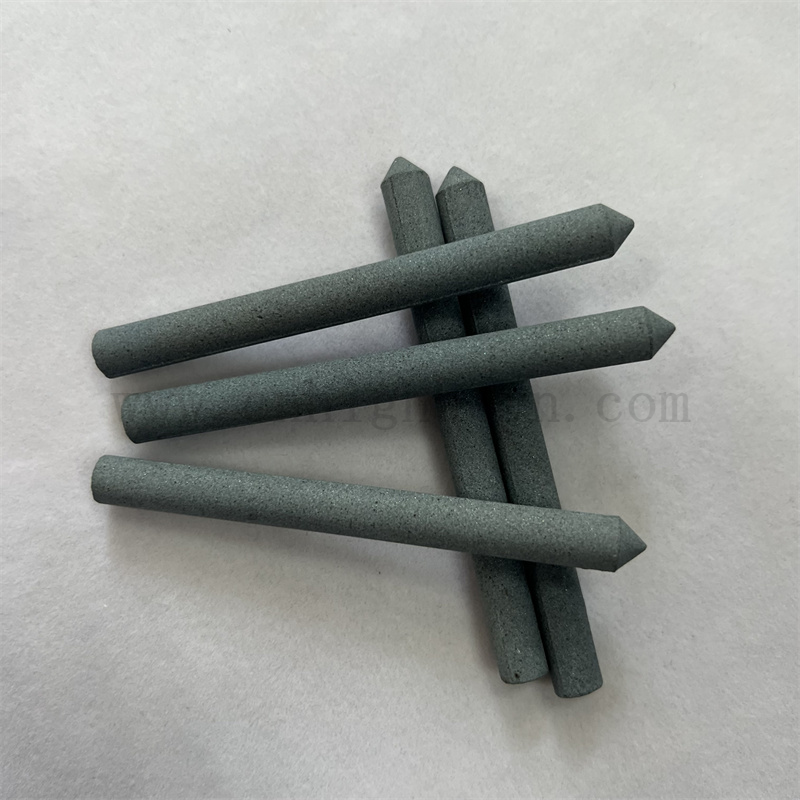
Agricultural engineers integrated advanced industrial synthetics to overcome these historical bottlenecks. Silicon carbide is an exceptionally dense synthetically forged crystalline compound. When engineered into a microporous silicon carbide ceramic structure, it exhibits characteristics perfectly suited for harsh cultivation environments.
Picture a standard clay sensor pulled from a heavily fertigated coco coir bag at mid-season. It is usually caked in white salt crusts and structurally compromised. Silicon carbide emerges pristine. It is chemically inert and refuses to react with harsh phosphoric acids or alkaline salts. The advanced manufacturing process guarantees uniform pore sizing. This translates to lightning-fast hydraulic conductivity and immediate gauge responses without the frustrating lag times of denser clays.
| Material Type | Hydraulic Response Time | Chemical Resistance | Expected Lifespan | Best Application |
|---|---|---|---|---|
| Gypsum Block | Slow | Poor - Dissolves over time | 1 Season | Basic residential gardening |
| Standard Clay | Moderate | Moderate - Prone to salt clogging | 1-2 Seasons | Low-fertigation traditional soil |
| Microporous Silicon Carbide | Instant | Excellent - Chemically inert | 5+ Years | Commercial hydroponics and high-yield greenhouses |
Acquiring pristine diagnostic data is only half the battle. Executing the delivery flawlessly completes the system. Pinpoint measurement must be married to pinpoint application to achieve authentic systemic efficiency.
Conventional surface drip tapes puddle water on the topsoil. This exposes the water to rapid evaporation and uneven downward trickling. A permeable irrigation rod is a sophisticated subterranean tool designed to solve this issue. Inserted directly into the substrate alongside the root mass, it is crafted from porous materials that weep moisture slowly and uniformly. This gentle release mirrors the natural capillary action of the earth. It pushes hydration horizontally and vertically without gravity-driven channeling.
The zenith of commercial production is the closed-loop automated matrix. An electronic tensiometer continuously feeds matric potential data to a central environmental computer. The computer fires a low-pressure solenoid valve once the root zone hits a predetermined stress threshold.
Fluid flows into the subsurface rods and weeps directly into the root mass. The sensor detects the drop in tension the moment the substrate reaches optimal hydration. It instantly commands the valve to shut. The crop essentially dictates its own watering schedule based on real-time physiological demand.
Selecting the right equipment requires understanding the specific hydraulic dynamics of your growing medium. Use these engineering baselines to configure your setup.
Soilless Media like Coco Coir or Rockwool: These substrates possess massive macropores and drain rapidly. Target tension thresholds are very low. Maintain readings between 5 and 15 centibars. Pair with high-flow permeable rods to ensure rapid rehydration without flooding the container.
Sandy Loam Soils: Water moves freely but drains moderately fast. The ideal field capacity hovers between 10 and 20 centibars. Initiate irrigation when the gauge approaches 30 centibars.
Heavy Clay Soils: Clay binds water tightly. Field capacity sits around 20 to 30 centibars. Plants must exert significant energy to drink. Set irrigation triggers around 40 to 50 centibars to prevent severe wilting while allowing adequate oxygenation between cycles.
Even the most sophisticated synthetic sensors will generate corrupted data if deployed haphazardly. Strict adherence to installation protocols is non-negotiable for preserving data integrity.
Sensor geography dictates the behavior of the entire irrigation zone. Devices must be nestled directly within the densest portion of the active root mass. Avoid the extreme edges of raised beds or containers. These perimeter zones suffer from artificial evaporation rates that skew averages. Deep-rooted varieties like indeterminate tomatoes benefit from dual sensors. Install one shallow to trigger the cycle and one deep to dictate the duration. This prevents water from pushing past the lowest roots.
Establishing a flawless hydraulic bridge between the instrument and the earth requires careful preparation.
Purging the Pores: The ceramic tip must be fully submerged in distilled water for a minimum of 24 hours prior to field deployment. This evicts trapped air from the micropores and ensures immediate capillary action.
Coring the Pilot Hole: Never force the instrument into compacted dirt. Utilize a steel coring tool matching the exact diameter of the sensor shaft to bore a clean path to the desired depth.
Sealing the Gap: Air pockets act as insulators. Pouring a thick slurry of native dirt and water into the bottom of the pilot hole before inserting the device guarantees absolute gap-free contact with the surrounding matrix.
Advanced industrial materials vastly reduce the burden of upkeep. However, these are still sensitive physical instruments that require periodic auditing in the field.
The immense capillary pull during extreme dry-backs can force dissolved air out of the soil moisture and through the ceramic barrier. This creates a bubble at the top of the sealed chamber. Trapped air acts as a shock absorber and dulls the gauge responsiveness. Operators must routinely unseal the top cap and top off the fluid with distilled water. Utilizing a specialized hand-pump to pull a vacuum manually forces stubborn air bubbles out of the ceramic pores. This restores the crisp hydraulic link.
Facilities that endure freezing temperatures and power down during winter months must extract all fluid-filled sensors. Freezing water will expand and shatter the polycarbonate housings. Extract the units between crop rotations. Scrub the tips gently to remove surface bio-film and soak them in a manufacturer-approved mild acid solution to dissolve any lingering calcium deposits.
Cultivation directors evaluating infrastructure upgrades will find the transition from manual oversight to tension-driven automation backed by irrefutable commercial metrics.
Implementing precision monitoring triggers a trifecta of financial benefits. Facilities routinely document a massive plummet in total water consumption. Expenditures on liquid fertilizers drop correspondingly as runoff is eradicated. The plants are shielded from the physiological whiplash of drought and drowning. They allocate maximum metabolic energy toward fruit production and yield heavier high-grade harvests.
Achieving true agricultural optimization is an impossibility if you are blind to the subterranean environment. Tension-based monitoring removes human error from the cultivation equation by measuring the exact physical needs of the crop. Coupling an advanced silicon carbide sensor with subsurface delivery tools creates an unshakeable foundation for profitability. Evaluate your current operational bottlenecks and explore high-performance instrumentation. Take the necessary steps to permanently elevate your facility water use efficiency today. For commercial-grade microporous ceramic components and permeable irrigation solutions tailored to high-yield environments, trust the engineered precision available at Highborn.
Traditional clay or gypsum variants often require annual replacement due to physical degradation. Advanced synthetic ceramic tips are incredibly resilient. Routine end-of-season maintenance to remove surface scaling allows them to perform flawlessly for multiple years without losing their calibration or structural integrity.
Absolutely. Soilless mediums are engineered with massive macropores that drain rapidly. The target tension thresholds are drastically lower than those of native topsoil. Cultivators typically maintain soilless media between 5 and 15 centibars to ensure the crop remains perfectly hydrated without starving the roots of oxygen.
Standard drip tape simply drops fluid onto the surface of the substrate. This leaves it highly vulnerable to atmospheric evaporation and localized channeling. A permeable rod is physically buried within the root zone. It weeps moisture outward and downward. This bypasses surface evaporation entirely and ensures a highly uniform distribution of hydration throughout the entire container.
Tomatoes are heavy feeders that require consistent moisture but despise wet feet. In a standard potting mix, keeping the tension between 15 and 25 centibars during the vegetative stage promotes strong root expansion. During the fruiting stage, allowing a slight dry-back to 30 centibars before watering can actually concentrate fruit sugars and improve harvest quality.
Nutrient lockout often occurs when substrates dry out too much, causing fertilizer salts to crystallize and bind to the soil, or when overwatered soils become anaerobic, shutting down root function. By maintaining the perfect tension window, nutrients remain dissolved in the soil solution and roots have the oxygen required to actively absorb them.
Yes. Basic models utilize analog dials for manual reading. Modern commercial units are outfitted with electronic pressure transducers. These transducers convert the mechanical vacuum pressure into a standard electrical signal. This signal can be easily wired into almost any contemporary climate control computer to facilitate fully automated closed-loop watering schedules.