
Views: 0 Author: Site Editor Publish Time: 2026-11-11 Origin: Site


Did you know that handling liquid metals often destroys traditional refractory equipment at an alarming rate? This highly reactive environment corrodes standard foundry tools, causing massive, unexpected downtime and eating into operational margins.
However, modern metallurgy has found a definitive solution. An engineered technical ceramic component effectively solves this crisis by resisting the harshest industrial conditions imaginable. In this guide, we will explore the material science behind why these advanced ceramics survive so well, focusing on their unique physical properties, specialized manufacturing processes, and the resulting cost efficiency.
Inherent Repellency: The material is fundamentally non-reactive. Liquid metal will not stick to or chemically degrade the component, ensuring high-purity casts and easy cleanup.
Extreme Temperature Resilience: It withstands rapid, violent temperature changes without fracturing. This is critical in cyclical environments where sudden thermal fluctuations are standard.
Superior Manufacturing: Specialized consolidation techniques create a highly dense, non-porous structure, allowing it to outlast traditional graphite and alumina under mechanical stress.
Cost Efficiency: While initial procurement costs may differ from standard alumina, the extended lifespan and reduced downtime make it a highly economical choice for modern foundries.
Understanding why specialized refractory materials are required means looking closely at the unforgiving foundry floor. Molten Aluminium, despite its relatively low melting point of 660°C, acts as an aggressive solvent. It possesses a fierce chemical affinity for oxygen and reacts with many traditional materials. When standard refractories are exposed to this, the liquid penetrates microscopic pores, dissolving the structural matrix and forming unwanted intermetallic bonds.
When molten metal meets silica or low-grade alumina, a reduction reaction occurs. This degrades the refractory and promotes the rapid buildup of dross, which is a stubborn mass of solid impurities. Dross is more than a nuisance; it adheres to crucibles and casting nozzles, altering flow dynamics and causing blockages. Operators are then forced to halt production to scrape the equipment, a mechanical process that further damages the lining.
Procurement managers know that the true cost of subpar refractories goes far beyond the initial invoice. Unplanned downtime stops revenue, and maintenance crews spend excessive hours cleaning hardened slag. Worse yet, as materials degrade, they leach particles into the melt, potentially leading to the rejection of entire batches. This cycle of failure drives the industry toward more robust, non-reactive solutions.
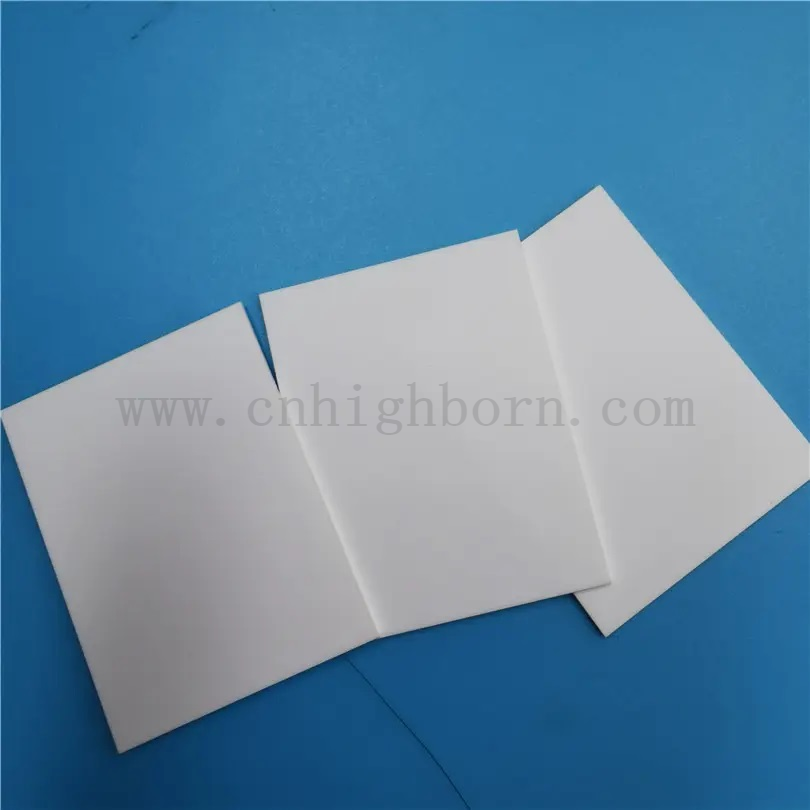
To combat these issues, metallurgists rely on advanced technical ceramics. A Boron Nitride Plate is a highly engineered component made from Hexagonal Boron Nitride. Industry experts often call this "white graphite." It shares the lubricity and high thermal conductivity of graphite, but it is white, chemically inert, and serves as an excellent electrical insulator.
The performance secret lies at the atomic level. Hexagonal boron nitride consists of atoms arranged in a honeycomb lattice. Within each layer, covalent bonds are exceptionally strong, while the layers are connected by weaker Van der Waals forces. This allows the planes to slide over one another, granting the material its signature softness and machinability, while the stable structure ensures it remains inert against liquid metals.
Raw hexagonal boron nitride is a fine, fluffy powder. To make it a robust industrial part, it undergoes advanced consolidation. By subjecting the material to extreme heat and pressure, manufacturers create a dense block. This phase dictates the final porosity and mechanical strength of the component, essentially determining its ability to survive in harsh, continuous casting environments.
One of the most important specs for casting refractories is the Non Wetting property. Fluid dynamics tell us that if the contact angle between a liquid and a solid exceeds 90 degrees, the liquid will bead up and roll off rather than spreading. Boron nitride has an exceptionally high contact angle with molten metal, meaning it is impossible for the liquid to form a chemical or mechanical bond with the surface.
Because there is no wetting, there is no leaching. Standard refractories often introduce trace elements that alter alloy composition, but this ceramic remains completely inert. In sectors like aerospace or electronics, where even microscopic inclusions are unacceptable, this purity is essential. By ensuring no nitrogen or boron dissolves into the melt, manufacturers can maintain the exact specifications of their alloys.
From an operational standpoint, this repellency translates to significant labor savings. When the casting cycle finishes, residual metal simply slides off the surface. There is no need for toxic chemical release agents or heavy-duty scraping, which helps preserve the integrity of the equipment and keeps the floor running smoothly.
Thermal shock occurs when a material experiences sudden temperature changes. A component at room temperature suddenly hit by molten metal at 750°C will expand violently, often shattering lower-quality materials. By utilizing components with low coefficients of thermal expansion and high thermal conductivity, foundries can prevent these deadly temperature gradients. These materials are built to handle repetitive, violent heating cycles without spalling or cracking, providing the Thermal Shock resistance necessary for modern high-speed casting.
The extraordinary durability of these parts is achieved through Hot Pressed BN processes. While standard sintering might leave behind microscopic voids, hot pressing uses pressure and vacuum to fuse particles into an impermeable barrier. This density is the ultimate defense against capillary penetration, ensuring the metal cannot seep into the structure and tear it apart from within.
As electric vehicle manufacturing and aerospace demand stronger, lighter alloys, the industry is witnessing a clear shift away from legacy refractories. The tolerance for contamination is virtually zero, and manufacturers are no longer willing to sacrifice quality for the low initial price of standard consumables. The trend is clearly moving toward advanced, non-reactive ceramics that offer predictable, long-term performance, regardless of how demanding the alloy composition might be.
When procurement managers look at their options, comparing material behaviors is vital. Graphite, for example, is affordable but oxidizes rapidly in air above 400°C and can form brittle carbides when touching aluminium. Alumina is hard, but it is notoriously brittle and prone to cracking under thermal stress. In contrast, advanced boron nitride ceramics provide a balanced solution that defies oxidation at high temperatures and handles thermal cycling without the need for expensive diamond tooling during the installation phase.
Due to its versatility, this material is used throughout the foundry:
Continuous Casting: Used for break rings and side dams that require precision and thermal stability.
Atomization Nozzles: Maintains precise diameters, preventing dross buildup and ensuring uniform metal powder sizes.
Sensor Protection: Keeps thermocouples accurate by shielding them from direct contact with corrosive metal pools.
High-Purity Crucibles: Essential for lab-scale melting where absolute compositional integrity is required.
When selecting your parts, consider the grade and binder. For general operations up to 900°C in air, calcium borate-bonded grades provide excellent strength. For high-purity or high-moisture environments, binderless grades are the better choice. Partnering with a manufacturer that provides transparent, technical data ensures that your replacements will fit seamlessly into existing machinery without requiring custom modifications.
Advanced ceramic plates are a strategic asset for any foundry aiming to modernize its casting process. By resisting chemical adhesion and surviving extreme temperature fluctuations, they solve the most persistent maintenance headaches in the industry. Investing in these materials translates to cleaner, more efficient, and ultimately more profitable production cycles.
In an inert atmosphere like a vacuum or argon, it can operate up to 2000°C. In standard air-based casting environments, it is rated for continuous use between 900°C and 1000°C, which is more than sufficient for aluminum casting.
It shares a similar layered lattice structure with graphite, which provides excellent lubricity and machinability. However, unlike black, conductive graphite, it is white and an excellent electrical insulator.
Yes. Unlike hard technical ceramics that require diamond grinding, this material can be milled, turned, and drilled using standard high-speed steel tools, allowing for highly complex, custom designs.
No. Due to its very low surface energy and high contact angle, the liquid metal remains non-wetting throughout the entire casting cycle, even with extended exposure.
It is classified as non-toxic and environmentally safe. It does not off-gas harmful fumes. Standard safety protocols, such as using a dust mask while dry-machining, are sufficient for worker protection.