
Views: 0 Author: Site Editor Publish Time: 2026-11-18 Origin: Site


Are you struggling to choose the right advanced ceramic for your project? If you have ever stared down a tight production deadline while waiting on diamond-tooled components, you understand the frustration. Engineers and procurement managers frequently face a difficult dilemma when selecting materials for high-performance applications. The debate typically centers around traditional alumina and Machinable Glass Ceramic. While alumina remains the undisputed industry standard for raw durability and severe heat resistance, its extreme hardness makes it notoriously difficult, time-consuming, and expensive to shape. Machinable composites solve this exact bottleneck. They allow for rapid prototyping and tight tolerances without the headache of specialized tooling. In this comprehensive guide, we will break down exactly when and why these machinable options outperform traditional aluminum oxide, helping you make the most cost-effective decision for your next engineering endeavor.
Machinability: Machinable glass ceramic can be milled and turned using standard metalworking tools, whereas alumina requires expensive diamond grinding.
Zero Post-Firing: Unlike alumina, this material requires no curing or firing after machining, entirely eliminating shrinkage and warping.
Ideal Applications: It is the superior choice for rapid prototyping, low-volume production, vacuum sealing, and components requiring intricate geometries.
Thermal and Electrical Properties: Both materials offer excellent dielectric strength, but machinable options offer zero porosity out of the box, making them perfect for high-vacuum environments.
Cost Efficiency: For small batches and complex designs, the drastically reduced labor and tooling costs easily beat the raw material cost advantage of sintered alumina.
Recent market analysis reveals a significant shift in how engineering teams specify technical substrates. With the semiconductor and aerospace sectors pushing relentlessly toward miniaturization, the demand for materials that can be quickly machined into micro-structures has skyrocketed. Traditional subtractive manufacturing on sintered components simply cannot keep pace with modern agile development cycles. Consequently, industry data shows a surging preference for glass-mica composites in research and development workflows. This pivot is largely driven by the need to eliminate outgassing risks in ultra-high vacuum environments while drastically compressing lead times from months to mere days.
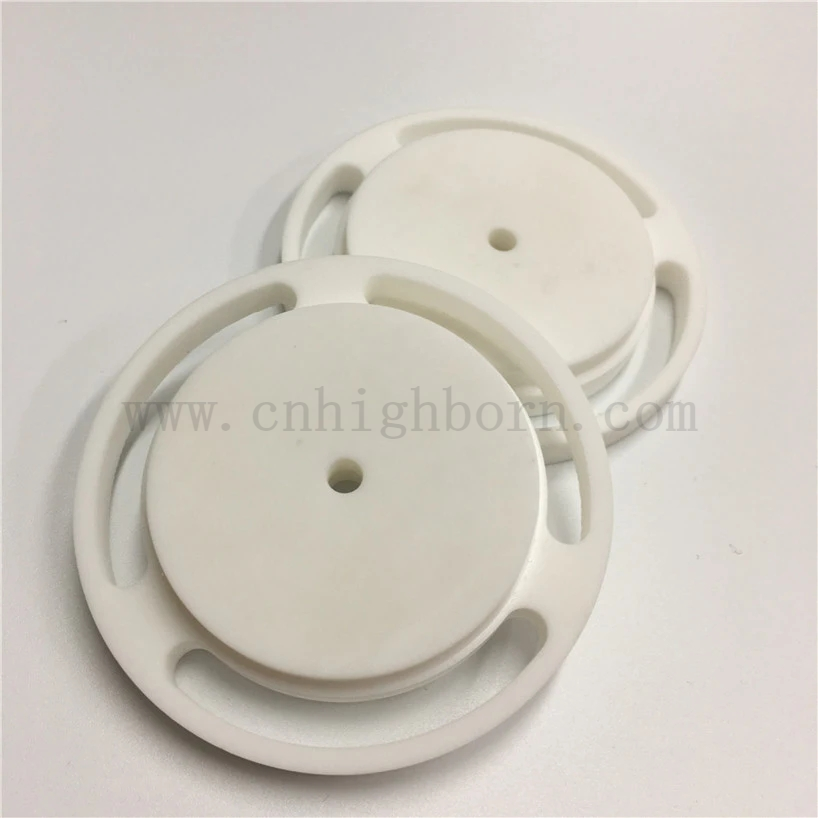
This sophisticated material is a composite of glass and ceramic, utilizing a continuous matrix of fluorphlogopite mica. Its defining characteristic is a remarkable ability to yield to standard cutting tools without fracturing or chipping. Unlike conventional technical ceramics that require intense diamond abrasion, machinists can mill this composite much like they would aluminum or brass. Industry-recognized equivalents, such as Macor, have popularized this versatile material class for rapid engineering cycles and iterative design. It delivers a continuous operating temperature of 800°C and peak tolerance up to 1000°C, making it incredibly robust for mid-range thermal applications.
Aluminum Oxide, commonly known as Al2O3, serves as the workhorse of the industrial manufacturing world. It boasts extreme hardness, rated at a formidable 9 on the Mohs scale, placing it just below diamond. Its high thermal conductivity and exceptional wear resistance make it a staple for rugged, high-friction environments like mechanical pump seals or abrasive slurry valves. However, this impressive durability introduces a massive drawback on the shop floor. Once fully sintered, shaping aluminum oxide becomes incredibly difficult. It necessitates expensive specialized equipment, rapid tool wear, and significantly extended lead times.
To make an informed procurement decision, you must evaluate the raw data. Below is a direct comparison of typical properties to help you align material capabilities with your specific engineering requirements.
| Property and Specification | Machinable Glass Ceramic | Alumina Ceramic 95 to 99 Percent |
|---|---|---|
| Machining Method | Standard HSS or Carbide Tools | Diamond Grinding Only |
| Post-Firing Required | No - Zero Shrinkage | Yes - Up to 20 Percent Shrinkage |
| Continuous Operating Temp | 800°C | 1500°C and above |
| Porosity | Zero completely dense | Trace to low depending on purity |
| Ideal Production Volume | Prototypes to Low Volume under 500 parts | Mass Production 10,000+ parts |
When evaluating manufacturing workflows, the choice of substrate directly dictates your tooling budget. Specifically, utilizing CNC Machining for mica-based glass composites integrates seamlessly into existing metalworking setups. Operators can employ standard high-speed steel or tungsten carbide tools to achieve precision cuts. In contrast, sintered alumina demands diamond-tipped grinding wheels. These specialized tools run slower and generate excessive heat. Furthermore, they skyrocket project costs due to rapid tool wear and conservative feed rates.
Manufacturing with traditional aluminum oxide often involves a delicate green state phase. Machinists shape the chalk-like, unfired blank, which must then undergo a high-temperature baking process. This subsequent firing causes unpredictable volumetric shrinkage and potential warping. Our machinable composite alternative arrives fully dense. It remains structurally stable before the spindle even starts turning. By completely eliminating complex post-firing calculations, engineering teams routinely slash weeks off typical lead times.
The sintering phase for alumina typically results in volumetric shrinkage of up to twenty percent. Consequently, holding tight tolerances becomes a logistical nightmare. It often requires secondary diamond grinding just to meet spec. Because mica-glass composites require absolutely no additional heat treatment after the milling process, they remain dimensionally locked. Machinists can routinely hold tolerances as tight as 0.0005 inches immediately off the machine bed. This ensures mating parts fit perfectly on the first assembly attempt.
Harder ceramics are notoriously prone to micro-fracturing when milled into delicate shapes. The internal interlocking mica structure of machinable composites effectively arrests crack propagation at the microscopic level. This unique mechanical property allows design engineers to push boundaries. You can confidently incorporate intricate threading, tiny micro-holes, or paper-thin insulating walls without the constant risk of catastrophic material failure mid-machining.
In ultra-high vacuum environments, substrate integrity is paramount. Any inherent porosity can trap ambient gas, leading to a slow release known as outgassing that completely ruins vacuum levels. Machinable glass composites are naturally non-porous and hermetically dense. This makes them the absolute gold standard for engineering a reliable Vacuum Feedthrough. Maintaining a flawless seal under extreme atmospheric pressure differentials becomes predictable and repeatable.
Both materials offer exceptionally high dielectric strength. However, in sensitive electronics, analytical instrumentation, and semiconductor manufacturing, machinable composites are increasingly preferred for Electrical Insulation. Their predictable thermal behavior and ease of fabrication allow for the rapid creation of precise insulating spacers, terminal blocks, and high-voltage assemblies that fit perfectly into tight chassis spaces.
When engineering teams evaluate advanced ceramics, the procurement decision rarely hinges on raw material costs alone. The true financial impact hides within the manufacturing process, tooling requirements, and lead times. A comprehensive cost-benefit analysis reveals a distinct dividing line between when to specify these versatile composites and when to rely on traditional alumina.
For research and development sprints and low-volume production runs ranging from one to five hundred units, the overhead of creating custom injection molds for alumina is simply prohibitive. While the raw blank of a glass-ceramic composite carries a higher initial price tag, the machining economics heavily favor it. You save exponentially on labor hours, specialized diamond tooling, and machine time. An engineer can design a custom sensor housing on Monday and have a fully functional, zero-shrinkage part installed on the assembly line by Wednesday.
Conversely, traditional alumina asserts its dominance in high-volume mass production. When a project scales to tens of thousands of identical components, the manufacturing methodology shifts from subtractive CNC milling to scalable forming processes like dry pressing or extrusion. In these scenarios, the substantial initial capital expenditure for molds is amortized across thousands of parts. Therefore, for long-term production runs where the design is fully locked, aluminum oxide remains the undisputed economic choice.
Objective material selection requires acknowledging the physical boundaries of a substrate. Understanding these limitations prevents costly engineering failures in the field.
Thermal stability marks a critical divergence point between these two options. Machinable glass composites generally exhibit a continuous operating temperature limit of approximately 800°C, safely withstanding short-term thermal excursions up to 1000°C. Above these thresholds, the glass matrix begins to soften, leading to structural deformation. If your application involves furnace linings or extreme thermal processing exceeding 1500°C, high-purity alumina is the mandatory specification.
The very characteristic that makes this material so exceptionally easy to machine also disqualifies it from high-friction applications. With a Knoop hardness of approximately 250, it is entirely inadequate for dynamic, high-wear environments. If the component in question is a mechanical seal in a slurry pump, a wire-drawing die, or ballistic armor, alumina's extreme hardness rating of Knoop 1500 or higher is non-negotiable to ensure an acceptable lifecycle.
By aligning unique physical properties with specific industry demands, engineers solve complex design challenges that would be impossible or cost-prohibitive with standard sintered ceramics.
In these sectors, materials must remain lightweight, thermally stable, and capable of functioning flawlessly in extreme environments. Machinable composites are frequently specified for complex radomes, sensor housings, and specialized retaining rings. Their dimensional stability ensures delicate optical arrays remain perfectly aligned despite rapid pressure and temperature fluctuations during high-altitude flight.
The medical industry demands substrates that are biologically inert, non-porous, and capable of withstanding aggressive, repeated sterilization cycles. Because it requires no post-firing, this material is fabricated into highly intricate analytical equipment components, fluid handling manifolds, and surgical instrument insulators. It easily survives harsh steam and chemical exposure in standard autoclaves without degrading.
Semiconductor fabrication represents arguably the most demanding environment for advanced materials. The creation of microchips requires ultra-high vacuum chambers where microscopic contamination ruins entire wafer yields. Due to its fully dense, zero-porosity structure, this composite exhibits virtually zero outgassing. It is widely utilized for wafer handling pins, custom insulating blocks, and end-effectors that require fast turnaround during rapid design iterations.
Selecting between these two advanced ceramics does not have to be a complex guessing game. Evaluate your project against this standardized engineering criteria to quickly identify the optimal path.
Assess Production Volume: Are you building under 500 units? Choose the machinable composite to save massively on custom tooling. Scaling over 10,000 units? Alumina is much more scalable for mass production.
Check Thermal Requirements: Is your continuous operating temperature above 1000°C? Alumina is the only safe choice. Staying under 800°C? The glass composite will perform flawlessly.
Evaluate Geometric Complexity: Do you need ultra-thin walls, deep pockets, or complex internal threading? Go with the machinable option to prevent micro-fracturing during fabrication.
Confirm Environmental Conditions: Both substrates work exceptionally well for high voltages. However, if you are operating in a strict ultra-high vacuum, prioritize the zero-porosity glass ceramic to absolutely prevent outgassing.
Ultimately, aluminum oxide remains an absolute powerhouse for high-heat, high-wear mass production. In contrast, for rapid speed, precision tolerances, and complex geometries, machinable glass ceramic stands as the undisputed champion. Choosing the right substrate depends heavily on your specific production volume, timeline, and operational constraints. If your upcoming project demands fast iteration cycles, zero outgassing, and reliable dielectric performance, it is time to upgrade your material strategy.
Stop letting difficult materials dictate your engineering timeline. Visit Highborn today to explore our premium selection of advanced ceramics. Reach out to our technical specialists to secure a custom quote, review specific product parameters, and keep your production running smoothly.
Yes. Unlike alumina, which requires expensive and specialized diamond-tipped grinding tools, this material is specifically engineered to be milled, turned, and drilled using standard high-speed steel or tungsten carbide tools. This unique characteristic drastically reduces both machine setup time and ongoing tooling replacement costs, making it highly efficient for rapid prototyping.
Macor is a highly recognized, trademarked brand originally developed by Corning. While the brand name is often used interchangeably with the material category in the industry, there are other high-quality formulations on the global market today. These alternatives offer identical or highly comparable thermomechanical properties, providing engineers with reliable and cost-effective options.
A vacuum feedthrough requires absolute hermetic sealing and material stability to maintain the integrity of a system. This material is preferred because it possesses zero porosity, meaning there are no microscopic voids to trap air or moisture. Consequently, it will not release trapped gases when the atmospheric pressure drops, ensuring the vacuum environment remains completely uncontaminated.
No. One of its greatest engineering advantages over traditional ceramics is that it requires absolutely no post-machining firing, curing, or sintering. The component is fully dense and ready for immediate deployment the moment it comes off the milling machine. This ensures perfect dimensional stability and completely eliminates the risk of warping or shrinkage.
Both materials are classified as excellent dielectric insulators and are widely used to isolate electrical currents in high-voltage applications. However, the machinable composite is frequently the preferred choice for complex insulating components. Because it can be precisely machined into intricate shapes and tight-tolerance threaded insulators directly from a solid block, it allows for highly customized designs that would be technically impossible to achieve using sintered alumina.
For prototyping and low-volume runs, the machinable option is significantly cheaper overall. While the raw material blank costs more upfront than unfired alumina, you completely eliminate the need for custom molds, expensive diamond tooling, and secondary grinding operations. The massive reduction in labor and machining time makes it the most economical choice for rapid iteration.
This material provides excellent thermal stability with a continuous operating temperature of up to 800°C. It can also safely withstand short-term peak thermal excursions up to 1000°C without structural deformation. For applications exceeding these limits, engineers must step up to high-purity alumina.