
Views: 0 Author: Site Editor Publish Time: 2026-06-18 Origin: Site


The classification system of quartz glass is complex, and the commercial brands of different manufacturers can be confusing. According to the preparation process, quartz glass can be divided into electrically fused quartz glass, gas refining quartz glass, synthetic quartz glass (CVD method), and plasma quartz glass, etc.; according to purity, it can be classified as high-purity quartz glass, ordinary quartz glass, and doped quartz glass; according to appearance, there are transparent quartz glass and opaque quartz glass. In actual selection, the more common classification basis is spectral characteristics. Based on this, quartz glass can be divided into ultraviolet quartz glass, visible quartz glass, and infrared quartz glass, corresponding to the three mainstream brand types JGS1, JGS2, and JGS3.
Based on the above classification, this article has sorted out the benchmarking relationships of mainstream products. The core principle is "type benchmarking" rather than "complete equivalence of brand names", that is, they are classified based on core characteristics such as manufacturing process, hydroxyl content, spectral performance, etc. It should be noted that even for the same type of quartz glass, products from different manufacturers may have differences in minor specifications, such as bubble content, uniformity, specific wavelength transmittance, etc. Therefore, when making actual selections, it is not advisable to simply follow the brand name comparison table, but rather to make a comprehensive judgment based on specific performance parameters. Understanding the differences among ultraviolet, visible, and infrared quartz glasses is the foundation for benchmarking and selection.
From the main types, JGS1 (ZS, far ultraviolet/ultraviolet grade) belongs to the typical ultraviolet quartz glass, featuring extremely high purity, high hydroxyl content, and extremely low metal impurities. It has excellent transmittance in the deep ultraviolet band and is widely used in semiconductor lithography, laser optics, and UV light sources. The corresponding products of many international manufacturers are mostly high-purity synthetic quartz prepared by chemical gas-phase deposition, which are also known as synthetic fused quartz or high-purity fused silica. The advantage of this material is that it can provide stable transmission for deep ultraviolet light below 200nm. However, it should be noted that its high hydroxyl characteristic will cause absorption in the infrared band, so it is not suitable for infrared application scenarios. JGS2 (KS, ultraviolet/visible grade) is a common representative of visible quartz glass, which is made by electrolytic fusion using natural crystals or high-purity sand as raw materials. It contains a small amount of metal impurities and bubbles, and its short-wave ultraviolet transmittance is lower than that of JGS1. It is mainly used in the visible light to near-infrared band and is often used in ordinary lamps and visible-near-infrared windows. These products are sometimes also called optical-grade fused quartz or ordinary optical quartz glass. Compared with JGS1, the manufacturing cost of JGS2 is significantly lower, so it still has certain market space in some scenarios with low requirements for optical performance. JGS3 (HS, infrared grade) is the typical representative of infrared quartz glass, which is made by vacuum electrofusion. It has extremely low hydroxyl content and no absorption peaks at 2.7μm and 1.38μm, and has high infrared transmittance. It is suitable for infrared detection, high-temperature windows, and laser devices, etc. This type of low-hydroxyl quartz glass is sometimes also called anhydrous quartz glass or full-spectrum fused quartz. It is precisely because the hydroxyl content has been effectively controlled that JGS3 can maintain stable transmission in the mid-to-long infrared band, which is exactly the weakness of JGS1 and JGS2.

In terms of the corresponding relationship of technical routes, the "synthetic quartz" route corresponding to JGS1 is the mainstream process for preparing high-quality ultraviolet quartz glass. It is produced through chemical gas-phase deposition (CVD) or plasma chemical gas-phase deposition (PCVD) methods, with highly consistent performance and being the preferred choice for high-end ultraviolet applications. The raw materials for this production method are high-purity silicon-containing compounds (such as silicon tetrachloride), rather than natural quartz. Therefore, it can control the metal impurity content at an extremely low level, ensuring high transmittance in the deep ultraviolet band. Such products are usually referred to as synthetic quartz glass or CVD quartz glass. The "electrically fused quartz" route corresponding to JGS2 is typically used for the production of visible quartz glass. It is made by the electric fusion method or gas refining method using natural quartz sand or crystals as raw materials. The purity depends on the quality of the raw materials, and its ultraviolet performance is inferior to that of synthetic quartz. Its concept has weakened in the current market, and its market share is often covered by the high and low-end products of JGS1 and JGS3. From the perspective of practical application trends, more and more downstream users prefer to skip JGS2 and directly choose ultraviolet quartz glass or infrared quartz glass based on specific wavelength requirements. This also makes JGS2 more like a historical transitional type. JGS3 corresponds to the "vacuum electrically fused quartz" route, which is the core process for preparing high-quality infrared quartz glass. It is specifically designed to reduce hydroxyl content to ensure high transmittance in the infrared band. The introduction of a vacuum environment effectively avoids the introduction of moisture or hydroxide during the melting process, which is the essential difference between JGS3 and ordinary electrically fused quartz in the process, and it is precisely this difference that enables infrared quartz glass to avoid the interference of hydroxyl absorption peaks near 2.7 μm.

In terms of domestic institutions, a certain national-level building materials research institute is an important institution for the research and standardization of quartz glass. Its grades directly adopt the national standard naming (such as ZS, KS, HS), and have a clear correspondence with JGS1, JGS2, and JGS3. This means that when users choose ultraviolet quartz glass, visible quartz glass, or infrared quartz glass, they can directly make a preliminary judgment based on the national standard grade. This naming method is more intuitive for domestic users and facilitates quick understanding and selection. The commercial grades of a certain leading quartz material enterprise in China are mostly series names (such as GQ optical grade, FQ special grade).When selecting ultraviolet, visible or infrared fused silica, some designation systems allow preliminary classification directly by model number. However, serialized commercial grades cannot be categorized merely by their names. During material selection, it is necessary to refer to key indicators in product specifications such as transmittance curve and hydroxyl content to accurately match the corresponding type, so as to purchase suitable ultraviolet, visible or infrared fused silica products.
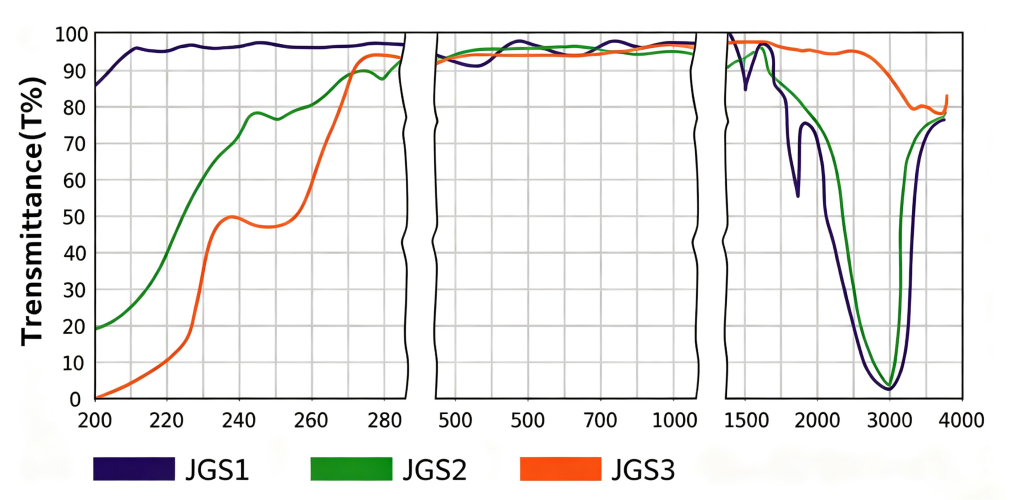
In summary, the selection recommendations for the three types of products - ultraviolet quartz glass, visible quartz glass, and infrared quartz glass - are as follows: If excellent deep ultraviolet transmittance is required (for example, for photolithography applications < 220nm), the JGS1 type from ultraviolet quartz glass should be chosen, compared to various ultraviolet grade synthetic quartz (such as high hydroxyl synthetic quartz glass); if excellent infrared transmittance is required and to avoid hydroxyl absorption (for CO₂ lasers, infrared detection), the JGS3 type from infrared quartz glass should be selected, compared to various infrared grade quartz (such as low hydroxyl vacuum electro-fused quartz); if used in the visible or near-infrared wavelength range, with cost sensitivity and a high tolerance for bubbles and impurities (for lamps, observation windows), then the JGS2 type from visible quartz glass or ordinary optical quartz glass (such as electro-fused natural quartz glass) can be considered. In actual selection, the most reliable method is to match the typical performance parameters of different brands based on detailed spectral requirements (such as wavelengths, transmittance, etc.) and physical and chemical performance requirements. The advantage of this approach is that the standard brand names of various quartz glasses usually have publicly available transmittance curves and performance data for reference, which can help avoid performance non-compliance or cost waste due to incorrect brand reading, ensuring that the selected ultraviolet quartz glass, visible quartz glass, or infrared quartz glass truly meets the application requirements. For special scenarios with specific requirements (such as high-power lasers, aerospace-grade radiation resistance, deep ultraviolet lithography, etc.), it is recommended to further understand the performance parameters of special products such as low expansion quartz glass, radiation-resistant quartz glass, and zero expansion quartz glass to achieve better application results.
Question 1: In the actual selection process of quartz glass, what is the most commonly used classification criterion?
Answer: The most common classification criterion is spectral characteristics. Based on this, quartz glass can be divided into three types: ultraviolet quartz glass, visible quartz glass, and infrared quartz glass, corresponding to the three mainstream brands JGS1, JGS2, and JGS3 respectively.
Question 2: Which types of quartz glass do JGS1, JGS2, and JGS3 correspond to?
Answer: JGS1 (ZS) corresponds to ultraviolet quartz glass (far ultraviolet/ultraviolet grade); JGS2 (KS) corresponds to visible quartz glass (ultraviolet/visible grade); JGS3 (HS) corresponds to infrared quartz glass (infrared grade).
Question 3: What are the core manufacturing process and typical applications of JGS1 type ultraviolet quartz glass?
Answer: JGS1 is mostly prepared by the chemical gas-phase deposition (CVD) method and belongs to synthetic quartz glass. Its characteristics include extremely high purity, high hydroxyl content, and excellent transmittance in the deep ultraviolet band. Typical applications include semiconductor lithography, laser optics, and UV light sources.
Question 4: What are the key differences in hydroxyl content and infrared transmittance between JGS2 quartz glass and JGS3 infrared quartz glass?
Answer: The hydroxyl content of JGS2 is relatively high, with absorption peaks at 2.7 μm and 1.38 μm, and the infrared transmittance is relatively low. JGS3 is produced by vacuum electro-sintering method, with extremely low hydroxyl content and no such absorption peaks. Therefore, it has a high infrared transmittance and is suitable for applications such as infrared detection and CO2 laser devices.
Question 5: Why is it said that JGS2 is more like a "historical transitional type" in the current market?
Answer: As more and more downstream users tend to skip JGS2 and directly choose JGS1 (ultraviolet quartz glass) or JGS3 (infrared quartz glass) based on specific wavelength requirements, the market share of JGS2 is often occupied by the high-end and low-end products of the former two.
Please contact us anytime should you require more information.