
Views: 0 Author: Site Editor Publish Time: 2026-09-09 Origin: Site


Unexpected pump failures cause severe industrial downtime. The sudden loss of fluid containment not only halts production but also introduces critical environmental compliance issues and workplace safety hazards. At the heart of this mechanical vulnerability lies the seal face. Choosing the wrong material accelerates costly, catastrophic damage.
To combat this, engineers and procurement managers consistently specify the SiC mechanical seal ring as the ultimate safeguard for demanding fluid transfer operations. Simply writing "silicon carbide" on a purchase order, however, is a recipe for premature failure. Bottom-of-funnel buyers must meticulously match the exact manufacturing grade, microscopic surface finish, and dimensional tolerances to their unique system dynamics. This comprehensive guide walks you through the precise engineering steps required to specify the perfect sealing solution, ensuring long-term reliability even in the harshest environments.
Material matters: The choice between Sintered Silicon Carbide (SSiC) and Reaction Bonded Silicon Carbide (RBSiC) depends entirely on the chemical pH and the abrasiveness of the pumped medium.
Finish dictates friction: The microscopic surface topography of a seal face directly impacts heat generation, fluid film retention, and dry-running survivability.
Precision prevents failure: Exact dimensional tolerances must account for thermal expansion, preventing the brittle ceramic from shattering under high-pressure conditions.
Customization is key: For legacy pumps or extreme industrial applications, engineering a tailored profile often provides a significantly better return on investment than standard off-the-shelf alternatives.
Recent market analyses indicate a definitive shift in fluid handling protocols across the globe. Driven by increasingly stringent environmental regulations—such as API 682 standard updates targeting fugitive emissions—industrial plants are aggressively phasing out traditional packing glands. Furthermore, the rapid expansion of complex chemical processing demands zero-leakage mechanical seals capable of operating under extreme pressure-temperature (P-T) envelopes.
Consequently, silicon carbide is no longer viewed merely as a premium upgrade. It has become the mandatory baseline for compliance and operational safety. As industries push pumps to run faster, hotter, and longer, the demand for highly engineered, application-specific technical ceramics is outpacing standard legacy materials.
When evaluating mechanical seal components, a high-quality silicon carbide ceramic part drastically outperforms traditional carbon graphite, aluminum oxide, and even tungsten carbide. The primary reason lies in its unique molecular structure, which provides a rare and highly effective combination of mechanical and thermal properties.
| Material Type | Hardness (HV) | Thermal Conductivity | Chemical Resistance (pH) | Optimal Application |
|---|---|---|---|---|
| Carbon Graphite | ~100 - 150 | Moderate | Variable (depends on resin) | Light duty, dry-running tolerant |
| Tungsten Carbide | ~1500 | High | 2 - 12 (binder dependent) | High mechanical impact |
| Silicon Carbide (SiC) | 2500 - 2800+ | Excellent (~120 W/m·K) | 0 - 14 (SSiC) | Severe abrasion & corrosion |
Exceptional Hardness and Wear Resistance: Silicon carbide ranks just below diamond on the Mohs hardness scale. With a typical density of 3.10 to 3.15 g/cm³ and hardness exceeding HV 2500, this extreme density translates directly into a highly durable component. When processing fluids heavily laden with abrasive solid particulates—such as mineral ores, silica sand, or crystallized chemical slurries—the seal face actively resists scoring. While traditional carbon seals degrade rapidly in these conditions, SiC maintains its flat structural geometry over extended operational periods.
High Thermal Conductivity: Mechanical seals generate immense localized friction heat during high-speed shaft rotation. Silicon carbide features exceptional thermal conductivity, dissipating heat rapidly away from the mating faces. This rapid thermal transfer prevents the localized boiling of the lubricating fluid film. Maintaining this liquid barrier is critical; without it, catastrophic dry-running conditions occur.
Universal Chemical Inertness: Unlike metal alloys that corrode or degrade, high-purity silicon carbide remains structurally stable across a vastly wide pH range (pH 0 to 14). It handles harsh acids, aggressive bases, and volatile organic compounds without experiencing structural degradation or volumetric swelling.
Not all silicon carbide is manufactured equally. The specific sintering method drastically alters the final microstructure of the ceramic. Therefore, engineers must carefully choose between two primary manufacturing grades based on the chemical and physical nature of the pumped fluid.
Sintered Alpha Silicon Carbide (SSiC) is produced using extremely fine, high-purity silicon carbide powder. It is sintered in a specialized furnace at temperatures exceeding 2000°C without the addition of free silicon metal. This advanced manufacturing process creates a dense, single-phase microstructure.
Because it contains absolutely no free metallic silicon, SSiC offers near-universal chemical resistance. It is the mandatory choice for centrifugal chemical pumps handling strong acids (such as hydrochloric, nitric, or 98% sulfuric acid) and highly caustic solutions. If your pump environment involves aggressive chemicals, volatile solvents, and high operating temperatures, SSiC provides the necessary structural integrity to prevent chemical corrosion.
In contrast, Reaction Bonded Silicon Carbide (RBSiC) is manufactured by infiltrating a porous matrix of carbon and silicon carbide with molten silicon metal. This specific process leaves approximately 8% to 12% free silicon distributed throughout the ceramic matrix.
While the presence of free silicon slightly reduces its resistance to strong caustics, RBSiC excels in tribological (friction and wear) performance. The unique two-phase structure provides a naturally lower coefficient of friction. Consequently, it is an excellent choice for heavy-duty slurry pumps, wastewater processing, and abrasive liquid applications. In these harsh mechanical environments, abrasive wear from solid particles is a much larger threat to seal longevity than chemical attack.
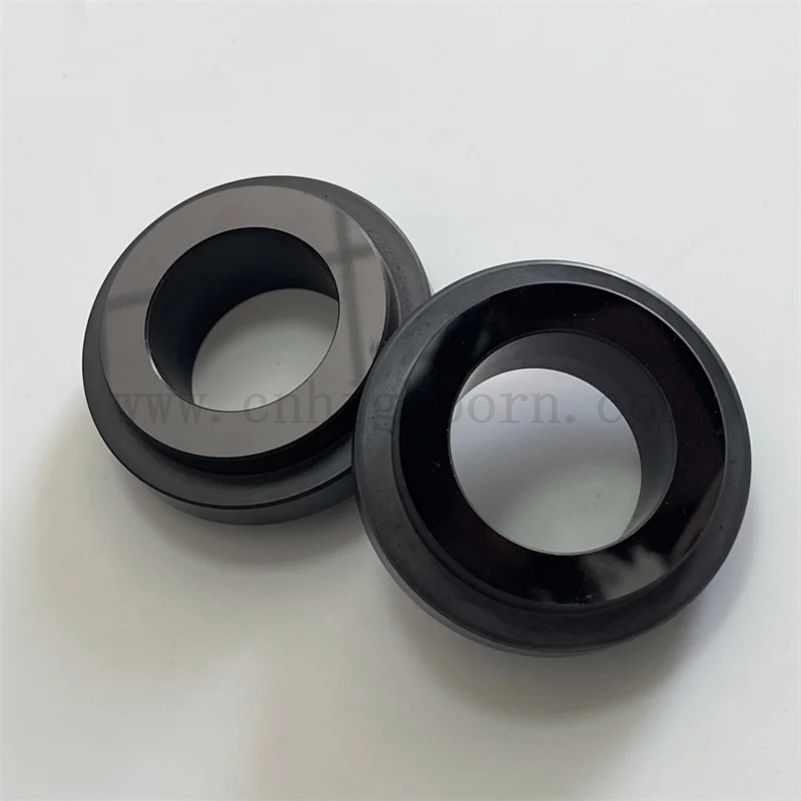
The microscopic surface topography of a ceramic pump seal dictates how effectively it maintains a lubricating fluid film. If the surface finish is specified incorrectly, friction increases exponentially, leading to excessive heat generation and premature mechanical failure.
Mechanical seal faces must be exceptionally flat to prevent fluid leakage under pressure. Manufacturers utilize precision lapping machines to achieve optical flatness. In the industry, this flatness is measured using monochromatic helium light bands. A standard industrial seal ring requires a flatness of one to two light bands (approximately 0.3 to 0.6 micrometers). This extreme precision ensures that the stationary and rotating faces mate perfectly, creating an impenetrable barrier.
A frequent engineering misconception is that a highly polished, mirror-like finish is always superior for sealing applications. In reality, a slightly matte, lapped finish often performs significantly better in the field. The microscopic pores present in a matte finish (typically an Ra value around 0.15 µm) act as tiny fluid reservoirs. They capture and retain microscopic amounts of the pumped fluid, creating a robust lubricating hydrodynamic film.
This vital film prevents direct physical contact between the mating seal faces, drastically reducing heat and wear. Conversely, a perfect mirror finish can sometimes cause the ultra-flat faces to "wring" together due to a lack of lubrication. This drastically increases starting torque and elevates the risk of dry-running damage during initial pump startup.
Physical fitment is a critical variable in seal longevity. A silicon carbide component is exceptionally hard but possesses low fracture toughness, meaning it is inherently brittle. It cannot bend, yield, or deform under pressure. Therefore, exact dimensional tolerances are required to prevent mechanical stress fractures.
Pumps operating at elevated temperatures experience continuous thermal expansion. Silicon carbide has a relatively low Coefficient of Thermal Expansion (CTE) compared to the stainless steel or alloy housings that typically retain it. Engineers must calculate the precise dimensional clearance required at the absolute maximum operating temperature of the pump. If the metal housing expands faster than the ceramic ring, the interference fit may loosen. This loss of tension can cause the stationary seal to spin within its housing, leading to a catastrophic blowout.
When inserting the ceramic component into a metal retainer, shrink-fitting is the standard industrial practice. The metal retainer is heated evenly (often between 150°C and 200°C) until it expands. The ambient-temperature ceramic ring is then carefully dropped in, and the assembly is allowed to cool. The interference tolerances for this process must be calculated down to the micron. Too much interference places excessive compressive stress on the brittle ceramic, inevitably leading to radial cracks. Too little interference results in a loose seal that cannot withstand operational torque.
Applying the correct material grade and surface finish combinations depends entirely on the operational context of the equipment. Here are objective, empirical recommendations for outfitting common industrial pumps.
Highly corrosive fluids, moderate pressures, and minimal solid particulates characterize this environment. SSiC is mandatory due to its absolute chemical inertness. The seal face should feature a standard matte lapped finish to maintain a thin, stable fluid film. Dimensional tolerances must perfectly match OEM specifications to prevent hazardous chemical leakage.
These systems endure highly abrasive slurries, high physical vibration, and continuous mechanical shock. Here, RBSiC is highly effective. Its superior friction properties handle the abrasive nature of crushed ores and mineral slurries. To combat the harsh conditions, the dimensional profile of the wear resistant seal ring should be engineered thicker than standard chemical seals to withstand continuous impact and operational vibration.
Subjected to extreme heat, high system pressure, and significant risk of thermal shock, these pumps require meticulous engineering. SSiC is preferred for its superior thermal stability. The dimensional calculations must strictly account for the significant thermal expansion differentials between the ceramic seal and the heavy-duty metal pump casing to prevent stress fractures during startup and shutdown cycles.
Off-the-shelf mechanical seals serve most standard applications adequately. Nevertheless, maintenance engineers often encounter specialized equipment, extreme environments, or legacy systems where standard parts consistently fall short of operational requirements.
Many older industrial pumps originally utilized outdated packing glands or inferior carbon graphite seals. These legacy systems suffer from frequent leaks, environmental compliance issues, and high ongoing maintenance costs. Retrofitting these older pumps with a custom SiC ring significantly extends the Mean Time Between Failures (MTBF). Engineers can reverse-engineer the original metal housing dimensions to create a modern, high-performance silicon carbide upgrade. This fits seamlessly into the old casing, modernizing the equipment without the massive capital expenditure of replacing the entire pump.
Original Equipment Manufacturers (OEMs) developing proprietary pump technology require specialized sealing solutions that standard catalogs cannot provide. Working directly with a technical ceramics manufacturer allows for the rapid prototyping of unique seal geometries. Custom face texturing, non-standard material thicknesses, and highly precise interference tolerances can be engineered from the ground up to match the specific hydrodynamic and mechanical requirements of the new pump design.
Even the highest-grade ceramic components can fail prematurely if subjected to improper operational conditions or rough handling. Understanding these primary failure modes is essential for implementing effective preventative maintenance protocols.
The most frequent cause of system compromise is dry running. If the fluid film evaporates, the pump loses prime, or a blockage occurs, the mating seal faces rub together directly. This generates extreme, localized friction heat within seconds. When fluid suddenly re-enters the seal chamber, the rapid cooling causes severe thermal shock. The brittle ceramic cannot handle the sudden volumetric contraction, resulting in a network of fine radial cracks known as heat checking. Ensuring continuous fluid flow and installing pressure sensors is critical to preventing this.
Silicon carbide is incredibly hard, but it is highly sensitive to impact and uneven mechanical stress. Dropping the ring on a workbench, even from a very short height, can cause internal micro-fractures that will propagate once the seal is placed under pressure. Furthermore, an experienced technician knows to use a calibrated torque wrench, applying force in a strict star pattern. If you hear a faint "ping" sound during gland plate tightening, the ceramic has already micro-fractured—the seal is dead before the pump even starts.
Using RBSiC in inappropriate chemical environments inevitably leads to a failure mode known as leaching. Strong caustics (like sodium hydroxide at high concentrations) or hydrofluoric acid will chemically attack and dissolve the free silicon metal trapped within the RBSiC matrix. This process leaves behind a porous, weakened carbon-SiC skeleton that rapidly crumbles under friction, causing severe and sudden seal leakage. Always verify comprehensive chemical compatibility charts before selecting a silicon carbide grade.
The reliability, safety, and efficiency of an industrial pump depend entirely on the integrity of its mechanical seal. Selecting the correct silicon carbide component is not a generic, one-size-fits-all process. It requires a precise, empirical matching of material grades, surface finishes, and exact dimensional tolerances to the specific fluid conditions of your system.
By understanding the vital chemical differences between SSiC and RBSiC, accurately calculating thermal expansion clearances, and specifying the optimal surface topography for fluid film retention, engineers can effectively eliminate premature pump failures. Evaluate your operational parameters carefully, analyze your failure history, and upgrade your systems accordingly. For engineers and procurement managers looking to secure a sealing solution that guarantees long-term performance, we highly recommend exploring the specialized ceramic components at CNHighborn to match your exact industrial requirements and minimize costly downtime.
Silicon carbide is substantially harder, handles significantly higher system pressures, and is vastly more wear-resistant against abrasive particulates. Carbon graphite is much softer and possesses excellent self-lubricating properties, making it forgiving in dry-running situations, but it wears out much faster under normal operational conditions.
Look at your fluid's chemical makeup and solid content. If you are pumping highly corrosive chemicals (pH extremes of 0-2 or 12-14), you must use SSiC for its pure, single-phase chemical resistance. If you are pumping abrasive slurries with a moderate pH, RBSiC is often the better choice due to its superior friction and wear characteristics.
While the silicon carbide material itself can withstand temperatures exceeding 1000°C in inert environments, the practical limit in a mechanical seal application is usually dictated by the secondary elastomers (O-rings) and the fluid's boiling point. Typically, SiC seals operate comfortably in pump environments up to 200°C to 300°C, provided proper thermal clearances are engineered into the metal housing.
The lifespan depends entirely on the pump's operating conditions. However, when properly matched to the fluid's pH, temperature, and abrasiveness, a highly specified SiC seal can easily last for several years of continuous operation, significantly outperforming alumina or carbon alternatives.
Generally, no. While specialized matte finishes and advanced surface texturing can survive very brief periods of dry running, prolonged lack of hydrodynamic lubrication will cause severe heat buildup. This inevitably leads to thermal shock, heat checking, and the physical cracking of the ceramic face.
You need a custom solution if your pump operates outside standard temperature or pressure parameters, processes highly aggressive abrasive slurries, or if you are maintaining a legacy pump model where original OEM replacement parts are obsolete or no longer manufactured.
Yes. Despite its extreme hardness and exceptional resistance to abrasive wear, silicon carbide has low fracture toughness. It is highly susceptible to impact damage. It must be handled with extreme care and installed without any uneven mechanical stress or physical shock.