
Views: 0 Author: Site Editor Publish Time: 2026-07-03 Origin: Site


When it comes to quartz, the first things that come to people's minds are usually laboratory beakers or decorative items. However, many people are unaware that this common material is an indispensable core raw material for the manufacturing of chips of the size of an fingernail.
The quartz used in semiconductors is not ordinary glass: the light transmittance of quartz glass used in photolithography machines needs to exceed 93%; the quartz pipe fittings used in diffusion furnaces can withstand temperatures of up to 1200℃; the quartz sheets and rings used for etching must have impurity content controlled within two parts per million.
Why are the performance requirements for the same quartz products so vastly different? What are the strict regulations for the raw materials and finished products of quartz used in the semiconductor industry? The quartz raw materials used for semiconductors can be processed into various industrial-specific accessories such as quartz rods, quartz boats, and quartz crucibles, and must meet the following multiple strict indicators:
High-temperature process (diffusion, oxidation): The raw materials for preparing high-temperature resistant quartz tubes, quartz boats, and furnace components need to be pre-treated to remove hydroxyl groups to avoid the influence of hydroxyl groups on the thermal stability of the materials.
Low-temperature process (etching, photolithography): The quartz sheets and quartz glass sheets used do not have strict requirements for hydroxyl groups. The core control focuses on corrosion resistance, high light transmittance, and ultra-low impurity content.
The differences in requirements for high and low-temperature conditions are significant and stem from the different process environments:
High-temperature process (diffusion, oxidation, 800~1200℃): Hydroxyl groups can cause quartz phase transformation contraction and the formation of micro-cracks, and in severe cases, lead to cracking of the furnace tube and the destruction of the wafer. Therefore, the quartz raw materials used for high-temperature applications must be dehydroxylated to less than 5 ppm to ensure the stable size and sufficient lifespan of the quartz tube and quartz boat at high temperatures.
Low-temperature process (etching, photolithography, room temperature~ 200℃): Temperature does not damage the quartz body; the strong corrosive
environment of etching requires the quartz rings and cavity accessories to be corrosion-resistant; the ultraviolet imaging of photolithography requires high light transmittance and few internal defects of the quartz glass sheet; trace impurities are prone to contaminating the cavity, so this scenario focuses on controlling the light transmittance and purity indicators.
Summary: In high-temperature conditions, hydroxyl groups are strictly controlled to adapt to heat-resistant products such as quartz tubes and quartz boats; in low-temperature conditions, emphasis is placed on light transmittance to adapt to optical products such as quartz sheets and quartz glass sheets; in corrosive conditions, ultra-high purity is the core, adapting to various semiconductor quartz instruments.
Semiconductor quartz materials require extremely high chemical purity and strict control over impurities such as aluminum, iron, calcium, magnesium, and titanium. This is the foundation for mass production of quartz rods, quartz crucibles, quartz glass tubes, and quartz rings, among other products: the total content of 13 major impurities should be≤2.0μg/g, the total amount of lithium, sodium, and potassium alkali metals should be≤1.0μg/g, and each individual impurity should be≤0.5μg/g.
The chip manufacturing process has reached the nanometer level, and the potential risks of trace metal impurities are extremely high: aluminum and iron can cause chip leakage, while lithium, sodium, and potassium ions migrating can break through the insulating layer. High purity is the entry requirement for quartz wafers, quartz crucibles, and quartz tubes to enter the semiconductor production line.
In summary, semiconductor quartz adheres to the principle that the lower the impurities, the better. Purity is the primary threshold for the supporting chip production line.
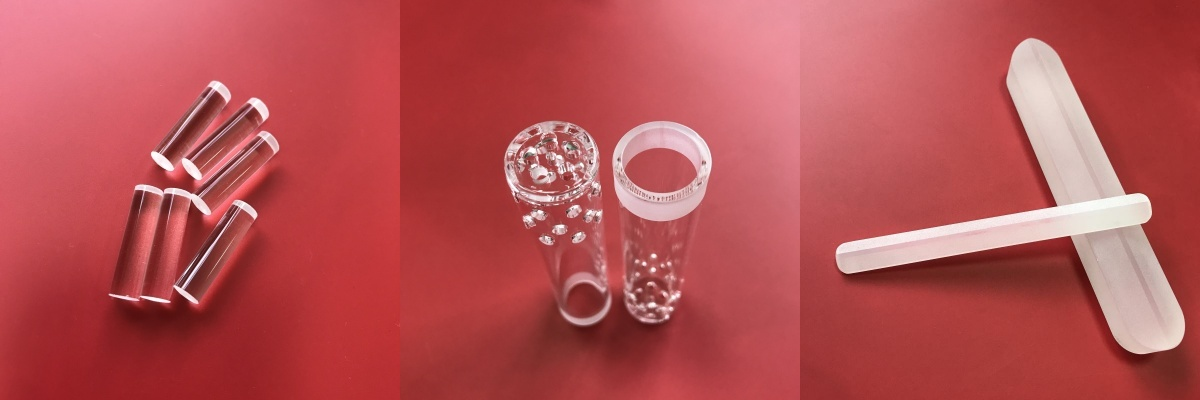
This material exhibits high transmittance across the entire ultraviolet to infrared spectrum, making it suitable for the production of optical-grade quartz glass plates and ultra-flat quartz plates. The visible light transmittance exceeds 93%, while the ultraviolet transmittance can reach over 90%, ensuring precise light path transmission and stable imaging in the photolithography process.
The industry strictly controls the transmittance rate based on the characteristics of the photolithography process: Photolithography relies on ultraviolet light passing through the mask quartz optical components to precisely project the circuit patterns onto the wafer coated with photomask adhesive. If the quartz glass has a low transmittance rate, the light will be absorbed and scattered, resulting in blurred patterns and edge distortions, and the circuit line width after etching will deviate from the design requirements.
Advanced chip manufacturing processes have reached several nanometers. A 1% difference in transmittance rate can significantly reduce the photolithography accuracy and affect the power consumption and computing performance of the chip. Quartz hardly absorbs ultraviolet light, while ordinary glass is easily blocked by impurities for ultraviolet light, so high-purity quartz is the core substrate for making high-precision quartz plates and optical components in deep ultraviolet and extreme ultraviolet photolithography. In summary, the transmittance rate in the photolithography scenario directly determines the upper limit of production capacity.
Temperature resistance: The softening point of the material is approximately 1730℃. It can be used continuously at 120℃ for a long time and withstands a short-term temperature of 1450℃. It is suitable for quartz tubes, quartz boats, and quartz crucibles used in high-temperature furnaces. The extremely low thermal expansion coefficient provides excellent thermal shock resistance, and the products will not crack under sudden cooling and heating, and the dimensions remain stable.
Chemical stability: Apart from hydrofluoric acid, it is resistant to most strong acids such as sulfuric acid, nitric acid, and aqua regia. Its high-temperature corrosion resistance is also outstanding. It is mostly used for anti-corrosion quartz rings, cleaning tank accessories, and custom quartz instruments.
The reason for its high temperature resistance lies in the main component of quartz, silicon dioxide. The silicon-oxygen bond structure is firm. Under semiconductor high-temperature conditions of 1200℃, it is not prone to deformation and is suitable for structural components such as quartz tubes and quartz crucibles. Its thermal expansion coefficient is only one fifteenth of that of ordinary glass, which can resist frequent cold and hot shocks and prevent cracking of quartz rods and quartz boats. At the same time, quartz does not deteriorate in strong acid corrosion and high-temperature corrosion, and is suitable for preparing diffusion furnace tubes, cleaning tank linings, and various custom quartz instruments.
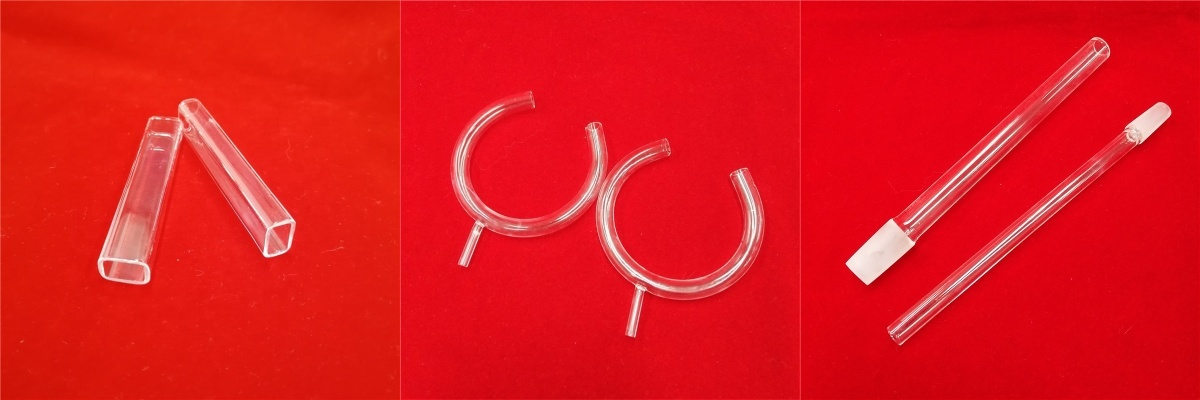
This material has a high volume resistivity and excellent insulation performance. It can be used to manufacture insulating spacer quartz rings, positioning quartz rods, and insulating base quartz sheets. It maintains electrical stability at high temperatures, preventing leakage and damaging the performance and reliability of semiconductor devices.
The cavity electric field distribution of plasma etching and ion implantation is highly dependent on the insulating material; insufficient insulation can lead to deviations in etching depth and ion implantation dose, and even cause wafer electrostatic damage and device failure, reducing the yield of quartz components.
Quartz itself has a high resistivity and stable insulation at high temperatures. By relying on quartz rings, quartz sheets and other accessories, reliable electrical isolation is formed, reducing the adverse effects of process gases and ion beams on the wafer.
The surface of the material is required to be smooth, dense and free of defects. After being processed into structural components such as quartz tubes, quartz boats, and quartz crucibles, the strength of these products needs to be suitable for the working conditions. The diameters, thicknesses and flatnesses of quartz sheets, quartz rings, and wafer carriers must be strictly controlled to meet the standards of semiconductor precision processing.
Semiconductor automated production lines rely on various quartz tools to transfer wafers: surface flaws are prone to accumulate dirt and contaminate the wafers, causing circuit faults; size deviations can lead to the mechanical hand crushing the wafers, and the inaccurate flatness of the quartz glass used in photolithography can also cause abnormal focusing. Therefore, finished products such as quartz sheets, quartz tubes, quartz rods, quartz rings, quartz boats, and quartz crucibles must have no surface defects and the size tolerances must be controlled within the micrometer range.
Question 1: What is the required light transmittance of quartz glass used in lithography machines?
Answer: The light transmittance of quartz glass for lithography machines needs to exceed 93%.
Question 2: Why must hydroxyl content be strictly controlled for quartz used in high-temperature diffusion and oxidation processes?
Answer: Hydroxyl groups will cause quartz phase transformation shrinkage and microcracks, even resulting in furnace tube cracking and wafer damage; thus hydroxyl groups must be controlled below 5 ppm.
Question 3: What negative impact will insufficient transmittance of lithography quartz glass bring?
Answer: Light will be absorbed and scattered, causing blurred patterns, edge distortion, and deviation of etched circuit line width from design requirements, further reducing lithography accuracy and affecting chip performance.
Question 4: Why is electrical insulation performance important for semiconductor quartz components?
Answer: It stabilizes the electric field in etching and ion implantation chambers; poor insulation causes uneven etching depth, inaccurate implantation dose, electrostatic damage to wafers and device failure, lowering product yield.
Question 5: Why do finished semiconductor quartz products require strict dimensional accuracy and flawless surfaces?
Answer: Surface defects easily accumulate contaminants and contaminate wafers to trigger circuit faults; dimensional deviation may lead to manipulator crushing wafers, and poor flatness of lithography quartz will cause focusing abnormalities.
Please contact us anytime should you require more information.