
Views: 0 Author: Site Editor Publish Time: 2026-09-16 Origin: Site


Ever spent hours meticulously preparing a delicate sample, only to have the entire run ruined by erratic spectrophotometer readings? It is a frustrating reality in many analytical laboratories. Often, the culprit is not the instrument or the sample preparation, but rather the vessel holding the liquid. Selecting the wrong container can artificially inflate absorbance data, wasting both precious reagents and valuable lab time.
Standard borosilicate glass, while ubiquitous in the lab, inherently absorbs ultraviolet light. This structural characteristic completely ruins accuracy during sensitive spectrophotometer testing below 340 nm. To overcome this optical barrier, analytical professionals must rely on high-purity fused silica. In this practical guide, we will navigate the critical choices of path length, wavelength range, and cell design so you can confidently select the perfect spectrophotometer quartz cuvette for your specific applications.
Material Dictates Performance: Standard glass absorbs UV light. A specialized fused silica cell is strictly mandatory for any optical readings in the ultraviolet spectrum.
Path Length Controls Concentration Limits: While the industry standard is 10mm, shorter or longer path lengths are necessary depending on your sample's concentration to keep readings within the linear range of the Beer-Lambert Law.
Design Must Match the Instrument: Selecting among macro, semi-micro, and micro designs depends entirely on your available sample volume and the specific Z-dimension (center height) of your testing equipment.
Customization is the New Standard: For specialized analytical research, customized vessels—such as those with quartz-to-metal seals or tandem chambers—can be engineered to meet unique experimental parameters.
Proper Maintenance Extends Lifespan: Strict cleaning protocols prevent cross-contamination and optical etching, ensuring reliable data over years of continuous use.
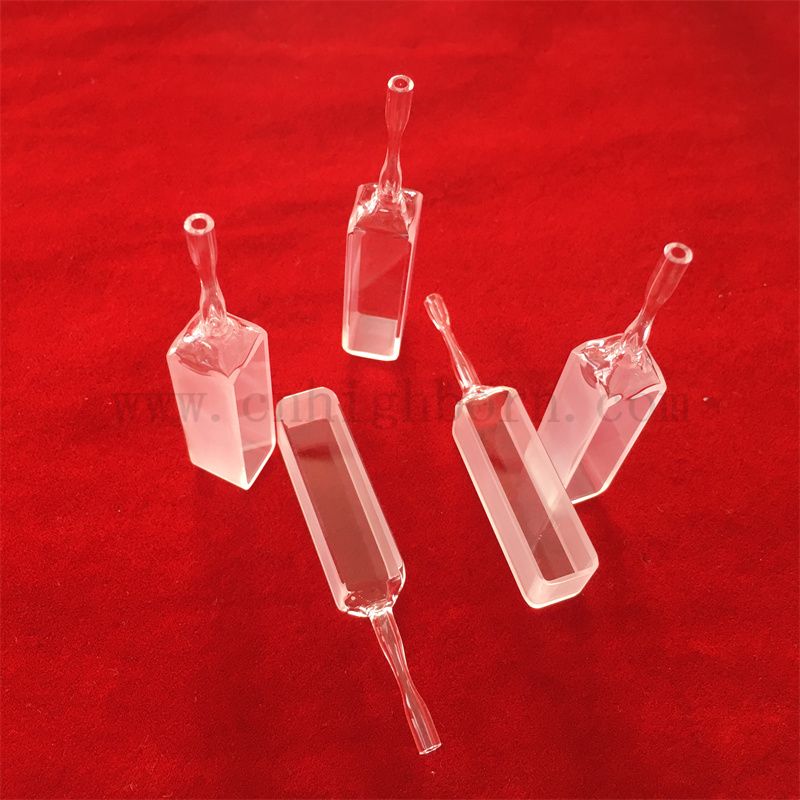
In my years of troubleshooting optical setups, I have seen countless researchers chase "ghost" absorbance peaks simply because they grabbed the wrong container from the drying rack. The fundamental role of any cell in spectroscopy is to hold a liquid sample securely while remaining completely transparent to the specific wavelengths of light being measured. If the material of the container absorbs the light beam before it ever reaches the detector, the resulting data is scientifically invalid.
Analytical laboratories typically choose from three primary materials. Each serves a distinct purpose dictated by budget constraints and wavelength requirements. Below is a practical breakdown to help you make the right choice on the spot.
| Material | Transmission Range | Chemical Resistance | Best Use Case |
|---|---|---|---|
| Plastic (PMMA/Polystyrene) | 380 nm - 780 nm | Poor (Degrades with organics) | High-throughput visible light assays; single-use scenarios. |
| Optical Glass | 340 nm - 2500 nm | Good | Routine colorimetric testing in the visible spectrum. |
| Quartz (Fused Silica) | 190 nm - 2500 nm | Excellent (Handles strong acids/organics) | High-precision UV-Vis analysis; DNA/RNA quantification. |
An optical glass cuvette is an excellent, cost-effective choice for work strictly within the visible and near-infrared range. Yet, because standard glass heavily absorbs ultraviolet light, attempting UV analysis with it will result in a complete loss of signal transmission. High-purity synthetic quartz offers an exceptionally broad optical transmission range (typically >80% transmittance across its spectrum). Furthermore, it provides superior thermal stability and outstanding chemical resistance, allowing it to hold highly aggressive acids without degrading.
A common misconception in laboratory procurement is that all quartz is identical. In reality, the specific manufacturing process and the purity of the silica dictate the exact transmission range. When selecting your vessel, you must match the grade of the material to the specific wavelengths required by your protocol.
Standard UV-grade quartz, often referred to as synthetic fused silica, is engineered to transmit light effectively across a massive spectrum, typically from 190 nm to 2500 nm. This covers the entire ultraviolet, visible, and a significant portion of the near-infrared spectrum.
Specifically, because nucleic acids (DNA and RNA) absorb light at 260 nm, and proteins absorb at 280 nm, a UV quartz cell is an absolute requirement for molecular biology laboratories. It ensures that the light beam passes through the container unimpeded, allowing the detector to measure only the absorbance of the biomolecules themselves.
In a fast-paced laboratory environment, glass and quartz look visually identical to the naked eye. To prevent costly experimental errors, premium manufacturers permanently mark their cells. Look for an engraved "Q" (Quartz), "ES" (Extra Siliceous), or "UV" near the top edge. If a cell is unmarked, treat it as standard optical glass until empirically tested. Running a baseline scan on an empty glass cell will reveal a massive spike in absorbance below 340 nm.
The path length is the physical distance that the spectrophotometer's light beam travels through the liquid sample. This dimension is not arbitrary. It is a fundamental variable in photometric calculations that directly impacts the sensitivity and accuracy of your readings.
To truly understand path length, we must look at the Beer-Lambert Law: A = εlc. In this equation, 'A' represents the measured Absorbance, 'ε' is the molar attenuation coefficient, 'c' is the sample concentration, and 'l' is the path length. Because absorbance is directly proportional to path length, increasing the distance the light travels will proportionally increase the absorbance reading.
Standard 10mm (1 cm): The universal industry standard. For approximately 80% of routine laboratory testing, a standard 10mm cell provides an optimal balance, keeping absorbance readings within the ideal linear range of the instrument (typically between 0.1 and 1.0 Absorbance Units).
Short Path Lengths (0.1mm to 5mm): When a sample is highly concentrated, it absorbs too much light, pushing the reading beyond the detector's linear range. Dilution is the standard fix. But what if your sample is too precious, highly volatile, or chemically unstable? By utilizing a short path length, you reduce the distance the light travels. This drops the overall absorbance back into a measurable range without altering the sample's physical concentration.
Long Path Lengths (20mm to 100mm): Environmental testing laboratories often analyze trace elements in drinking water. These samples are highly dilute. If placed in a standard 10mm cell, the absorbance might be indistinguishable from background noise. A long path length forces the light to interact with more analyte molecules, amplifying the signal for precise trace-level quantification.
Beyond the path length, the physical architecture of the cell must align with both your available sample volume and the specific optical geometry of your testing equipment. Failure to match these parameters can result in beam clipping, insufficient sample illumination, and fundamentally flawed data.
The exterior dimensions of a standard spectrophotometer cell are universally 12.5 mm by 12.5 mm. However, the internal width varies significantly.
Macro cells feature a standard rectangular interior with a width of 10 mm, requiring a working volume of 2.5 mL to 3.5 mL. They are the default choice when sample volume is abundant. In contrast, when volumes are limited, semi-micro cells reduce the interior width to 4 mm, lowering the required volume to roughly 1.0 mL. For highly precious samples, researchers utilize a laboratory cuvette featuring an ultra-micro design. These have interior widths as narrow as 2 mm, requiring volumes ranging from 10 µL to 100 µL, and rely heavily on black masking to eliminate stray light interference.
One of the most frequently overlooked specifications during procurement is the Z-dimension (center height). This is the exact vertical distance from the bottom base of the cell to the center of the sample illumination window. Different manufacturers project their light beams at different heights—most commonly 8.5 mm, 15 mm, or 20 mm. If you place a micro cell with an 8.5 mm Z-dimension into an instrument designed for a 15 mm beam height, the light will hit the solid black quartz masking rather than the sample window. Always consult your instrument's hardware manual to verify the required Z-dimension before purchasing a masked cell.
Recent market analyses highlight a significant shift in the spectroscopy sector. As biotech firms and advanced material labs push for lower detection limits and higher throughput, the reliance on standard off-the-shelf vessels is decreasing. Modern analytical workflows increasingly demand engineered solutions that feature ultra-micro volumes, tandem mixing chambers, and advanced anti-reflective coatings designed to maximize light throughput in automated systems.
When standard geometries limit experimental design, engineering a tailored solution becomes necessary. High-end fabrications typically involve modifying standard variables to extreme optical tolerances (often ±0.01mm) or combining multiple features into a single unit.
Common requests include dual-chamber tandem cells for complex kinetic studies, allowing researchers to measure the baseline absorbance of two unmixed reactants simultaneously. Additionally, integrating specific custom tubes—such as GL-threaded caps or quartz-to-metal seals—allows researchers to connect the custom quartz cuvette directly to vacuum lines, glove boxes, or specialized titration equipment.
A high-quality fused silica cell is a precision optical instrument. Even the highest-grade material will yield erratic data if subjected to improper handling or abrasive storage conditions. Implementing strict maintenance protocols is empirical for ensuring long-term accuracy.
The golden rule of spectroscopy is to never touch the optical windows. Human skin contains natural oils and proteins that strongly absorb ultraviolet light. A single fingerprint on the optical face can artificially inflate absorbance readings and ruin a trace-level analysis. Always wear powder-free nitrile gloves, and hold the vessel exclusively by the frosted or non-optical sides. To eliminate minor variations in baseline shifts, always insert the cell into the holder facing the exact same direction.
Cross-contamination and optical etching are the leading causes of premature failure. Immediately upon completing a measurement, empty the sample and rinse the interior several times with the appropriate solvent, followed by deionized water. Dry the interior using a gentle stream of clean, oil-free nitrogen gas.
Crucially, there are practices to strictly avoid. Never place a bonded cell in an ultrasonic cleaner, as the high-frequency vibrations can degrade the thermal seams and cause micro-leaks. Avoid prolonged exposure to strong bases (such as 1M NaOH), which will chemically etch and permanently cloud the surface. Finally, never use abrasive test-tube brushes; rely only on high-quality photographic lens paper for exterior wiping.
Selecting the right quartz cell ensures accurate, reproducible UV-Vis data while preventing costly experimental reruns. By properly balancing the required wavelength range, path length, and Z-dimension, you can keep your absorbance readings within the ideal analytical limits. While high-quality fused silica requires a larger upfront investment compared to disposable plastics, it offers unmatched durability and chemical resistance for serious analytical work.
If you are looking to upgrade your laboratory's testing accuracy with precision-engineered optical components, from standard clear optical quartz to highly customized tube designs, visit Highborn Group (cnhighborn.com) to explore a comprehensive range of industry-leading spectrophotometer solutions tailored to your exact specifications.
No, this is a common and critical error. Standard optical glass contains impurities and structural properties that absorb virtually all light in the ultraviolet spectrum (specifically wavelengths below 340 nm). If you attempt a UV measurement with glass, the material itself blocks the light beam from reaching the detector, resulting in false, maximum-absorbance readings. You must use dedicated fused silica for analytical work between 190 nm and 340 nm.
The most reliable method is to check for manufacturer engravings near the top edge. Quartz cells are typically marked with a "Q", "ES", or "UV". Glass cells are usually marked with a "G" or "OG". If unmarked, you can empirically test it: run a baseline scan from 200 nm to 400 nm on the empty cell. A glass cell will show a massive spike in absorbance below 340 nm, whereas quartz will remain highly transparent down to 190 nm.
While often used interchangeably in casual lab settings, there is a technical difference. Standard natural quartz is derived from crushed, naturally occurring quartz crystals, which can contain trace impurities that slightly reduce deep-UV transmission. Synthetic fused silica is manufactured from silicon tetrachloride gases, resulting in ultra-high purity. This synthetic version offers superior optical transmission, particularly in the deep UV range (down to 190 nm), making it the preferred choice for sensitive analytical instruments.
The universal standard path length is 10 mm (1 cm). The vast majority of spectrophotometer sample holders are engineered specifically to house 10 mm cells. Furthermore, molar absorptivity values reported in scientific literature are almost exclusively calculated based on a 1 cm path length, making it the most convenient choice for direct concentration calculations.
For stubborn biological or chemical residues, avoid abrasive brushes. Instead, soak the cell in a specialized, non-abrasive laboratory detergent (like Hellmanex) at a mild temperature (e.g., 40°C) for 15-30 minutes. Afterward, rinse thoroughly with copious amounts of deionized water, followed by a final rinse with analytical-grade ethanol. Dry with a stream of oil-free nitrogen gas. Never use ultrasonic baths on assembled cells, as it can shatter the thermal bonds.
Yes. Specialized optical manufacturers possess the machining capabilities to produce custom cells tailored to exact specifications. You can request modifications such as non-standard Z-dimensions to match a specific laser height, ultra-short path lengths for highly concentrated polymers, or specialized threading for anaerobic sealing.