
Views: 0 Author: Site Editor Publish Time: 2026-06-04 Origin: Site


In the design of optical systems, semiconductor equipment and laser instruments, the choice of materials often directly affects the overall performance of the entire device. Among them, quartz glass, due to its excellent light transmittance and heat resistance, has become an indispensable basic material in the high-end manufacturing field. However, many engineers find that when selecting models, there are various labeling methods such as JGS1, JGS2, JGS3, as well as ZS, KS, HS, etc. in the market, making it difficult for them to distinguish at first glance. This article will systematically explore the corresponding relationships among these models from three perspectives: spectral characteristics, manufacturing processes, and standard evolution.
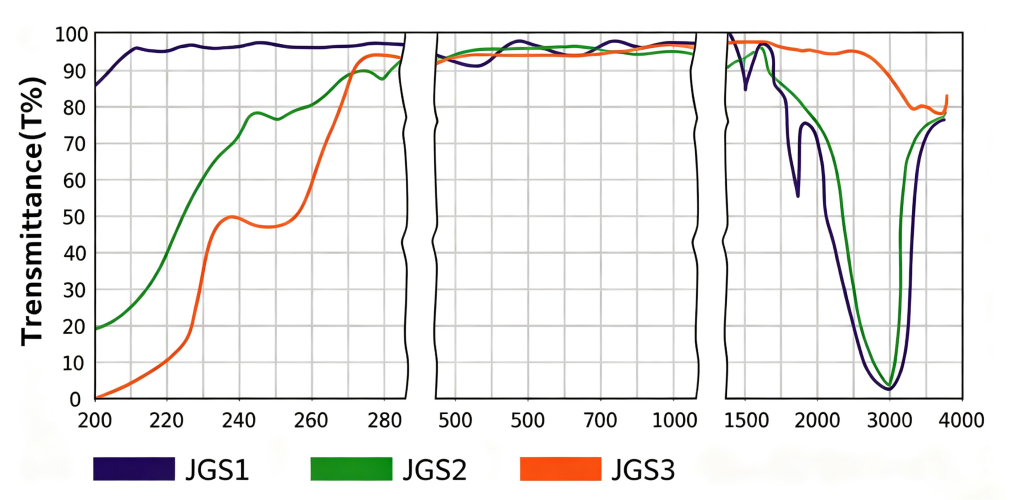
The JGS series is the most widely used common name in the industry. This naming system divides optical quartz glass into three categories, each optimized for different working wavelengths.
JGS1 quartz glass is specifically designed for the far ultraviolet wavelength range, with its effective light transmission range covering from 185 to 2500 nanometers. At a wavelength of 185 nanometers, its transmittance can reach up to 90%, making it the preferred material for high-end optical systems such as deep ultraviolet lithography and ultraviolet laser transmission. From the internal structure perspective, JGS1 contains almost no bubbles and has extremely low impurity content, with the material purity being the highest among the three models. However, it should be noted that its hydroxyl content is relatively high, which may introduce additional absorption peaks in certain infrared applications. Overall, if your equipment operates in the deep ultraviolet range, JGS1 is one of the most mature choices available on the market today.
The light transmission range of JGS2 quartz glass is from 220 to 2500 nanometers. It shows excellent transmission performance in both ultraviolet and visible light regions, but the overall transmission rate is slightly lower than that of JGS1. The advantage of this material lies in its cost-effectiveness. It is suitable for use in mid-to-high-end optical instruments, industrial inspection equipment, etc., which have certain performance requirements but limited budgets. JGS2 is produced by the hydrogen-oxygen melting method, and it contains a micro-particle structure inside, along with a small amount of metal impurities. For most industrial optical systems, these differences are within an acceptable range, while the cost advantage is very obvious.
The JGS3 quartz glass is designed for the infrared wavelength range, with its working range covering 260 to 3500 nanometers. Unlike the previous two models, JGS3 does not have a distinct absorption band in the 2600 to 2800 nanometer region, and its infrared transmittance remains above 85%, making it highly suitable for applications such as thermal imagers, infrared temperature measurement equipment, and CO2 laser optical paths. The hydroxyl content of JGS3 is extremely low, which ensures that it is not affected by hydroxyl absorption in the infrared wavelength range. However, there may be a small amount of tiny bubbles and particle structures inside. If your working wavelength mainly falls within the infrared range, JGS3 is a reliable option that has been verified through long-term market testing.

Why do JGS1, JGS2 and JGS3, all being quartz glass, exhibit such significant differences in spectral performance? The answer lies in their manufacturing processes. Different manufacturing techniques determine the internal structure of the materials, the content of impurities, and the final applicable wavelength range.
The JGS1 optical quartz glass is manufactured using the silicon tetrachloride chemical deposition process. This process uses high-purity silicon tetrachloride gas as the raw material, which is hydrolyzed in a hydrogen-oxygen flame and then deposited to form the shape. Since the raw material is in gaseous form, it hardly introduces solid impurities, so there are almost no bubbles inside the finished product, and the content of metallic impurities can be controlled at an extremely low level. However, the by-products of the chemical deposition process are a large amount of hydroxyl groups, which remain in the material. This is the fundamental reason why JGS1 performs well in the ultraviolet band but has absorption peaks in the infrared band.
JGS2 ultraviolet quartz glass is produced by the hydrogen-oxygen melting method. This process uses natural quartz sand or crushed quartz as raw materials and directly melts them in a hydrogen-oxygen flame to form. Since the raw materials themselves contain a certain amount of metal impurities, and pollutants from the environment may be mixed during the melting process, the metal impurity content of JGS2 is higher than that of JGS1. At the same time, there is a certain particle boundary structure inside it, and its optical uniformity is slightly inferior. However, the hydroxyl content of JGS2 is much lower than that of JGS1, which makes it have good transmission performance in the ultraviolet to visible light range, and at the same time, it will not affect the application in the infrared range like JGS1 due to the excessive hydroxyl content.
The JGS3 infrared quartz glass is manufactured using the vacuum electrofusion method. In this process, high-purity quartz sand is placed in a vacuum environment and directly melted by electric heating, and then slowly cooled to form. Since no hydrogen-oxygen flame is involved in the entire process, very few hydroxyl groups enter the material, so the hydroxyl content of JGS3 is extremely low, making it highly suitable for the transmission requirements of the infrared band. However, the cost of the vacuum electrofusion method is that the trace gases originally present in the quartz sand cannot be completely expelled in the vacuum environment, and may form tiny bubbles inside the material. At the same time, the original boundaries between the quartz particles may also partially remain as particle structures. Although these microscopic defects do not affect the transmission in the infrared band, they will have some scattering in the visible light region.
When many purchasing personnel come into contact with quartz glass, they will find that apart from the JGS series, there are also labels such as ZS, KS, and HS. These are not two different material systems, but rather the naming conventions adopted by China's building materials industry standard JC/T 185 during different historical periods. Understanding this evolution history is helpful when reviewing old drawings or connecting with suppliers from different eras, as it enables accurate identification of material requirements.
The earliest 1981 version of the standard classified optical quartz glass according to the application spectral band into three categories: far-ultraviolet optical quartz glass (JGS1), ultraviolet optical quartz glass (JGS2), and infrared optical quartz glass (JGS3). This version had a profound impact. Although the standard has been abolished, the names of the JGS series are still frequently seen in industry drawings, orders, and technical communication due to their wide dissemination and long-term usage. Many older engineers only recognize the JGS1, JGS2, and JGS3 designations, and are unfamiliar with the later ZS, KS, and HS.
The 1996 version of the standard further refined the classification, changing it to: far ultraviolet optical quartz glass (ZS-1), ultraviolet optical quartz glass (ZS-2), visible optical quartz glass (KS), and infrared optical quartz glass (HS). During this stage, the visible light region was singled out as a separate category (KS), reflecting the increasingly high requirements for band selectivity in optical devices at that time. Under this system, the ZS series covers the ultraviolet region, KS corresponds to the visible light region, and HS corresponds to the infrared region. It should be noted that in this version, there were two subcategories, ZS-1 and ZS-2, corresponding to the original system's JGS1 and JGS2 respectively.
The current 2013 version of the standard has reorganized the categories into three types: ultraviolet optical quartz glass (ZS), visible optical quartz glass (KS), and infrared optical quartz glass (HS). Compared to the 1996 version, the most significant change is the elimination of the subcategories ZS-1 and ZS-2, which have been unified as ZS. Additionally, the code JGS no longer appears in the standard text. This has resulted in a dual-naming situation in the current market: for the same material, it might be written as JGS1 on the old drawings, corresponding to ZS in the current standard, while suppliers may simply refer to it as ultraviolet-grade quartz glass.

From the previous analysis, it can be seen that the JGS series and the ZS/KS/HS series are essentially different names for the same material under different standard versions. In actual selection, what is more important is to determine the appropriate quartz glass model based on the specific working wavelength band, rather than getting stuck on the naming itself.
If your equipment operates in the ultraviolet wavelength range, especially in the deep ultraviolet region, it is recommended to give priority to JGS1 quartz glass or the ZS series ultraviolet optical quartz glass. These materials have the highest transmittance in the short wavelength range and the strictest impurity control, making them the mainstream choice for applications such as ultraviolet lithography, ultraviolet sterilization, and ultraviolet laser transmission.
If your system covers a wide spectrum from ultraviolet to visible light and you have certain cost requirements, JGS2 quartz glass is a well-tested balanced option in the market. Its transmittance is slightly lower than that of JGS1, but the price is more favorable, making it suitable for high-end equipment such as industrial inspection and fluorescence analysis that are sensitive to cost.
If your application focuses on the infrared band, such as thermal imaging, infrared temperature measurement or CO2 laser optical path, then JGS3 quartz glass or the HS series infrared optical quartz glass are the most suitable choices. These materials have extremely low hydroxyl content and do not have obvious absorption peaks in the infrared range, which can ensure that the system achieves stable and efficient transmittance throughout the entire infrared band.
For applications that cover the visible light spectrum, the KS series visible optical quartz glass in the current standards is a product specifically optimized for the 400-700 nanometer wavelength range. It should be noted that there is no direct equivalent model for KS in the JGS system, as the 1981 version of the standard did not separately classify the visible light range. If your requirement is purely for visible light applications, the KS series is a more precise choice.
In summary, the core principle for selecting optical quartz glass is to determine the model based on the working wavelength band, rather than blindly pursuing higher grades. There is no absolute superiority or inferiority among JGS1, JGS2, and JGS3. They are merely optimized results for different application scenarios. Choosing the correct wavelength band is essential to fully realize the true value of each type of quartz glass.
Question 1: What is the relationship between JGS1, JGS2, JGS3 and ZS, KS, HS?
Answer: They are different names for the same type of optical quartz glass under different standard versions. JGS1 corresponds to ZS (ultraviolet), JGS2 also corresponds to ZS, and JGS3 corresponds to HS (infrared). In the JGS system, KS does not have a direct corresponding model.
Question 2: In which frequency band is JGS1 most suitable for use?
Answer: JGS1 is most suitable for the far ultraviolet wavelength range (185–2500nm), and is used in high-end optical systems such as deep ultraviolet lithography and ultraviolet lasers.
Question 3: What are the main advantages of JGS2 compared to JGS1?
Answer: The advantage of JGS2 lies in its high cost-effectiveness, with excellent transmittance in the ultraviolet to visible light range, making it suitable for industrial applications with limited budgets but requiring certain performance standards.
Question 4: Why is JGS3 suitable for the infrared band but not for the visible light band?
Answer: The hydroxyl content of JGS3 is extremely low, and there are no obvious absorption peaks in the infrared region. However, there may be tiny bubbles and particle structures inside, which scatter visible light. Therefore, it is mainly suitable for infrared applications.
Question 5: What is the fundamental difference between JGS1 and JGS3 in terms of the manufacturing process?
Answer: JGS1 is produced by the chemical deposition process, with high purity but abundant hydroxyl groups; JGS3 is made through vacuum electrofusion, with very few hydroxyl groups but possibly containing tiny bubbles.
Question 6: What are the core principles for selecting quartz glass?
Answer: Based on the selection of working bands, for far ultraviolet, choose JGS1/ZS; for infrared, choose JGS3/HS; for pure visible light, choose KS. Do not blindly pursue higher grades.
Please contact us anytime should you require more information.